
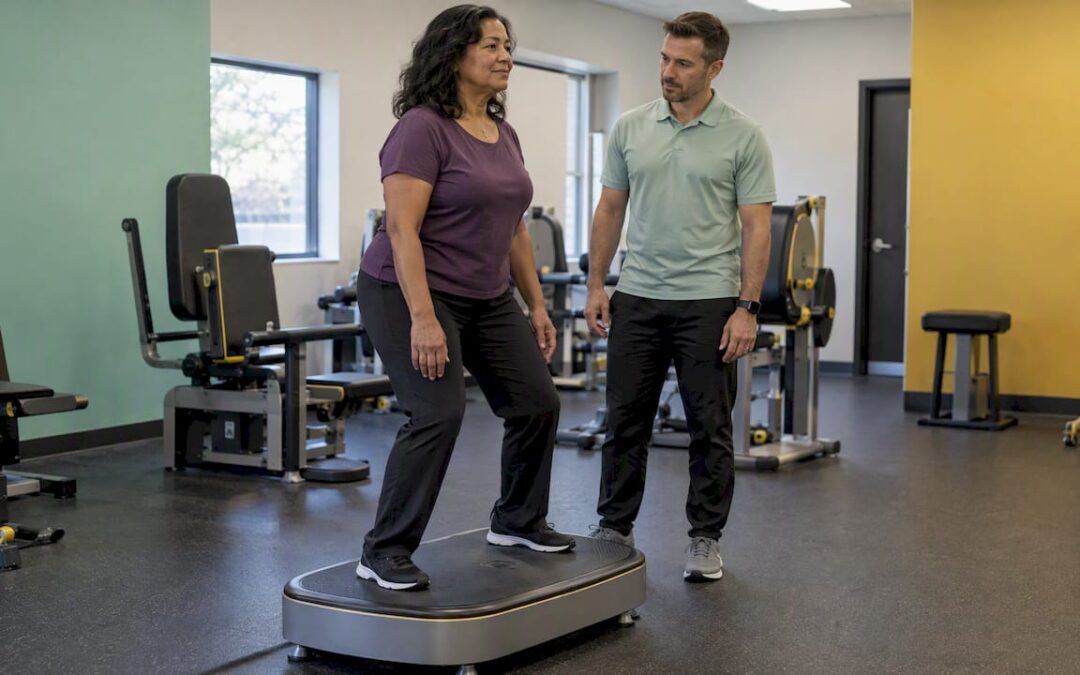
A beginner vibration plate session is short: roughly 5 to 10 minutes at a low setting, standing or doing a simple move while holding a stable support, and stopping at the first sign of discomfort. The University Hospitals guidance describes that same starting point for people cleared to use whole body vibration. If you have osteoporosis or osteopenia, the details matter more, because device strength, balance and your medical history change what is safe. This guide walks through the session step by step.
TL;DR
- A first session is about 5 to 10 minutes at low intensity, with hands on a rail, wall or sturdy support.
- No one has established the ideal mix of frequency, intensity and duration, so start small and build slowly.
- Vibration may help muscle strength and balance, which lowers fall risk, but evidence for direct bone gains is limited.
- With osteoporosis, a pacemaker, joint implants, balance problems or recent surgery, talk to your doctor or physical therapist first.
- Stop right away if you feel dizzy, nauseated or in pain.
Table of Contents
- What a vibration plate session actually involves
- How long should a beginner session last?
- A simple first routine
- What the evidence says for osteoporosis and osteopenia
- Device strength matters: low versus high intensity
- Who should check with a doctor first
- Eating, timing and the “10 minutes equals what” question
- Perspective: how we think about vibration in a bone-health plan
- Try a supervised session near Sacramento
- What to look for before your first plate session
- Tracking progress without overpromising
- FAQ
- Sources
What a vibration plate session actually involves
A vibration plate is a platform that oscillates. You stand on it, sit on it, or hold an exercise position while it moves under you. The movement makes your muscles contract and relax rapidly, which is why gyms and physical therapy clinics use it for warm-ups, balance work and gentle conditioning.
A typical session has four parts:
- Setup. You step on carefully, with the plate off, and find your footing. Many platforms have handrails, and the Royal Osteoporosis Society notes that you should take extra care getting on and off to avoid a fall.
- Acclimation. A few minutes of simple standing while you get used to the sensation. Northwell Health suggests holding a wall or sturdy furniture for balance at this stage.
- Movement (optional). One or two basic exercises such as a shallow squat or a step-up, only once you can do them well without the plate.
- Cool-down. Step off slowly, wait for any tingling or lightheadedness to fade, and note how you feel.
That is it. The session is not a workout in the sweat-and-soreness sense. It is a controlled, low-demand exposure that you build on over weeks.
How long should a beginner session last?
Start at 5 to 10 minutes. University Hospitals recommends beginners use that range at a low intensity so the body can adjust, then increase duration and intensity gradually.
You will see bigger numbers online: 15 to 30 minutes, three to five times a week. Those figures come from fitness and weight-loss content, and they are not set standards. The University of Rochester Medical Center states plainly that there is no scientific data on the ideal combination of frequency, intensity and duration. Their practical advice is to keep sessions short, begin at low intensity and build up gradually.
For someone with low bone density, that is the right posture to take. Treat any online number as a ceiling to approach slowly, never a target to hit in week one.
How often to go
Because there is no proven schedule, the sensible approach is conservative: begin with a couple of short sessions a week, notice how your legs, back and balance respond over a few weeks, and only then add time. If you work with a physical therapist, ask them to set the weekly frequency for you. Our own guide to vibration plate frequency settings covers the 15 to 30 Hz range we see used for bone and balance goals.
A simple first routine
Here is a beginner structure that follows the cautious guidance above. It assumes your doctor has cleared you for whole body vibration.
| Step | What to do | Time |
|---|---|---|
| 1 | Stand on the plate (off), hands on rail or wall, knees slightly soft | 1 min |
| 2 | Turn it on at the lowest setting. Stand still, spine tall, knees slightly bent | 3 to 5 min |
| 3 | Optional: a few shallow squats, only if you have mastered them without the plate | 1 to 2 min |
| 4 | Turn off, wait for the plate to stop, step down using the support | 1 min |
The posture cues come from the University of Rochester guidance: use handles or sturdy support, keep knees slightly bent and the spine straight. Locked knees send the vibration straight up your spine, which is exactly what you want to avoid.
Exercises to add later
Northwell advises that you master squats, push-ups or step-ups without the plate first, begin with one or two, and add more as you grow stronger and more comfortable (source). If you want a short pre-exercise version, see our quick activation protocol.
When to stop
Stop the session immediately if you feel discomfort, nausea or pain, per University Hospitals. Dizziness or faintness deserves the same response. Weill Cornell Medical Center points out that lightheadedness on the platform can lead to falls, which is the last thing anyone with fragile bones needs.
What the evidence says for osteoporosis and osteopenia
The honest picture is nuanced, and you should know it before you invest time.
The Royal Osteoporosis Society explains that vibration may not directly build bone, but it is valued in physiotherapy and gyms for its potential to improve balance and muscle strength, which lowers the risk of injury. Its summary adds that some research shows whole body vibration may improve muscle strength, balance and physical performance in older adults, which can reduce falls and fall-related fractures.
On bone density itself, Harvard Health reports that evidence is limited, and Dr. Elizabeth Matzkin of Brigham and Women’s Hospital prefers traditional weight-bearing activity such as lifting, walking or running for bone health. Weill Cornell likewise notes that trials in postmenopausal women with osteoporosis generally found no meaningful improvement in bone density.
What does that mean for you? It means a vibration plate session is best thought of as a balance, muscle and conditioning tool, one piece of a broader bone-health plan alongside resistance work, nutrition and your clinician’s guidance. Our evidence summary on vibration plates and osteoporosis and the page on whole body vibration benefits for bone and muscle go deeper.

Why balance matters so much
For people with low bone density, the fracture often follows a fall. Anything that sharpens balance and leg strength attacks the problem from the other side. If improving mobility in later life is your goal, general guidance on improving mobility in older age pairs well with supervised plate work. We also cover this in using vibration plates for balance and balance training for seniors.
Device strength matters: low versus high intensity
Not all plates are alike. In their 2015 review, Thompson, Yen and Rubin explain that devices range from under 1 g to over 15 g of acceleration, and that workout devices commonly above 4 g are inappropriate for elderly or frail patients seeking bone benefit.
The 2013 review by Chan, Uzer and Rubin adds that safety depends on frequency, exposure time and acceleration, that high-intensity signals can create fracture risk, and that people with osteoporosis should avoid high-intensity protocols. The Academy of Geriatric Physical Therapy guideline similarly cautions that high-frequency, high-magnitude activity may cause stress reactions or structural failure in women with osteoporosis.
The takeaway: a commercial gym plate cranked to a fitness setting is a different experience from a gentle, supervised, low-magnitude session. Weill Cornell notes that some platforms exceed 1 g and may be substantially riskier than low-intensity devices. Ask the operator for the device’s frequency and acceleration range before you step on. For more on gentle settings, read our page on low-intensity vibration for osteoporosis.

Who should check with a doctor first
Vibration is not appropriate for everyone. The University of Rochester lists safety risks for people with severe osteoporosis, back problems or acute injury, cardiovascular conditions, implanted medical devices, balance issues or frailty, pregnancy, retinal detachment and uncontrolled epilepsy. University Hospitals adds blood clotting disorders and a history of heart attack, stroke or vertigo. Chan, Uzer and Rubin name fresh surgical wounds, recent joint implants, pacemakers and cochlear implants.
Harvard Health adds two more cautions: people with balance problems should be careful because vibration can cause a fall, and people with stress incontinence should be wary.
If any of this describes you, speak with your physician or a physical therapist before your first session, and bring the device details with you. Our pages on vibration plate contraindications and vibroacoustic contraindications list these in more detail.
Eating, timing and the “10 minutes equals what” question
Two questions come up constantly. We could not find an authoritative medical source that sets a rule for eating before or after a plate session, so we will not invent one. A practical approach is to avoid going on a very full stomach, since nausea is a reason to stop a session, and to stay hydrated. Your clinician can tailor that to your medications and health.
The second question, what 10 minutes on a plate equals in other exercise, has no verified answer either. Because vibration produces muscle contractions without the load of walking or lifting, a minute on the plate is not a minute of jogging, and Dr. Matzkin’s preference for weight-bearing activity in the Harvard piece points the same way. Treat the plate as a complement, not a calorie or bone-loading substitute.
Perspective: how we think about vibration in a bone-health plan
We see people with osteoporosis and osteopenia who are tired of being told to “just exercise” with no guidance on how. A vibration plate session can be a gentle, approachable entry point. It is short, it is supervised, and it gives you a chance to build confidence on your feet.
Our core focus is osteogenic loading, a brief weekly session designed to stimulate bone, and we offer vibration plates alongside red light therapy, PEMF mats, BioCharger, compression therapy and hydromassage. We view vibration as one tool in that wider program, aimed at balance, muscle readiness and recovery, and we keep settings conservative for people with low bone density.
Our advice is simple: start low, hold on, listen to your body, and tell your care team what you are doing. Consistency over weeks matters far more than any single session.
Aaron
Try a supervised session near Sacramento
If you would rather not figure out settings on your own, we can help. Our centers in Rancho Cordova, El Dorado Hills and Granite Bay offer in-person sessions built around osteogenic loading, one brief supervised visit a week, with supporting therapies such as vibration plates available as part of a broader wellness approach.
See how a weekly visit works and find your nearest center on the OsteoStrong Sacramento page. To understand what the weekly loading is designed to do, read our overview of weekly osteogenic loading for osteoporosis.
What to look for before your first plate session
A short checklist makes the first visit calmer:
- A supervised setting. Someone nearby who can help you on and off and adjust settings.
- A stable support. Rails or a wall within reach.
- Known device settings. Frequency and acceleration, with a low-intensity option.
- Your clinician’s okay. Especially if you have implants, heart conditions or a recent injury.
- Comfortable, flat shoes or bare feet, whichever the operator recommends, so your footing is steady.
- A plan to stop. Decide ahead of time that dizziness, nausea or pain ends the session.
The University Hospitals article also stresses that you should check with a doctor before starting any new exercise program, and that is worth repeating for anyone managing low bone density.
Tracking progress without overpromising
After a few weeks, look for practical signs: do you feel steadier when you stand on one leg, is rising from a chair easier, do your legs feel more awake? Those are the outcomes the research supports as plausible. Bone density changes on a scan take far longer and depend on the whole program, not on vibration alone. Our page on clinic vibration plate results for osteopenia explains why we weigh balance gains alongside DXA numbers.
FAQ
How long do you stand on a vibration plate?
Beginners typically stand for 5 to 10 minutes at a low intensity, per University Hospitals. Increase time gradually over weeks. No proven ideal duration exists, so shorter and steadier is the safer approach.
Is a vibration plate safe if I have osteoporosis?
It depends on severity, device strength and your other conditions. University of Rochester Medicine lists severe osteoporosis as a risk, and reviews advise avoiding high-intensity protocols. Talk with your doctor or physical therapist first, and choose a low-intensity, supervised setup.
Should I eat before or after a session?
We found no authoritative guideline. Many people prefer not to go on a full stomach because nausea is a reason to stop. Ask your clinician if you take medications that affect blood pressure or blood sugar.
What exercises can I do on the plate?
Start by simply standing with your hands on a support. Later, add one or two moves you can already do well without the plate, such as shallow squats or step-ups, as Northwell Health advises.
Will a vibration plate build bone?
Evidence for direct bone-density gains is limited, according to Harvard Health. The more supported benefit is better muscle strength and balance, which can reduce fall risk. Pair it with weight-bearing and resistance activity your clinician approves.
Sources
- Vibration therapy for osteoporosis: Can it help? (Royal Osteoporosis Society)
- Using a vibration plate: What it can and can’t do for your body (Harvard Health)
- Do Vibration Plates Work? What Orthopaedic Experts Say (University of Rochester Medical Center)
- The Potential Benefits and Inherent Risks of Vibration as a Non-Drug Therapy (Chan, Uzer, Rubin, 2013)
- Vibration therapy: clinical applications in bone (Thompson, Yen, Rubin, 2015)
- Physical Therapist Management of Patients With Suspected or Confirmed Osteoporosis (Academy of Geriatric Physical Therapy, 2022)
- Whole Body Vibration Therapy (Weill Cornell Medical Center)
- Can Vibration Plates Improve Your Fitness? (University Hospitals)
- Vibration Plates: Benefits and Downsides (Northwell Health)