

Supervised vibration-plate therapy can help maintain bone density and often improves balance, strength, and fall risk, but reliable, sustained DXA increases in bone mineral density are inconsistent and depend heavily on the skeletal site measured. Functional improvements (strength, balance) tend to be more consistent than structural bone density changes. Used correctly, it belongs alongside medication, resistance training, and nutrition, not instead of them. In-clinic osteogenic-loading programs pair supervised sessions with the kind of measurement discipline this evidence demands.
TL;DR:
- Most studies show that vibration therapy primarily maintains bone density rather than reliably increasing it, with site-specific improvements seen in some bones like the lumbar spine.
- Functional gains such as strength and balance are more consistent and tend to manifest within weeks, whereas bone density changes generally take six to twelve months to become measurable.
- A responsible program should document and share specific protocol details, including frequency, acceleration, session duration, and follow-up DXA and functional test schedules.
- Medical clearance is necessary for individuals with fractures, implants, pacemakers, or severe cardiovascular conditions, and sessions should be carefully supervised to avoid risks from high acceleration levels.
- Vibration therapy is an adjunct to, not a replacement for, medication, resistance training, and nutritional strategies, with evidence supporting its role mainly in fall prevention and balance improvement.
Table of Contents
- What Do Vibration Plate Results Actually Look Like in the Research?
- Bone Density vs. Balance and Strength: Which Result Should You Expect?
- How Long Before You See Vibration Plate Workout Results?
- Who Needs Medical Clearance Before Starting?
- How Do You Tell a Credible Vibration Program From a Gimmick?
- Does Vibration Plate Therapy Replace Medication or Exercise?
- An Evidence-First Approach to Osteogenic Loading
- Ready to Add Supervised Osteogenic Loading to Your Bone Health Plan?
- Sources
- FAQ
What Do Vibration Plate Results Actually Look Like in the Research?
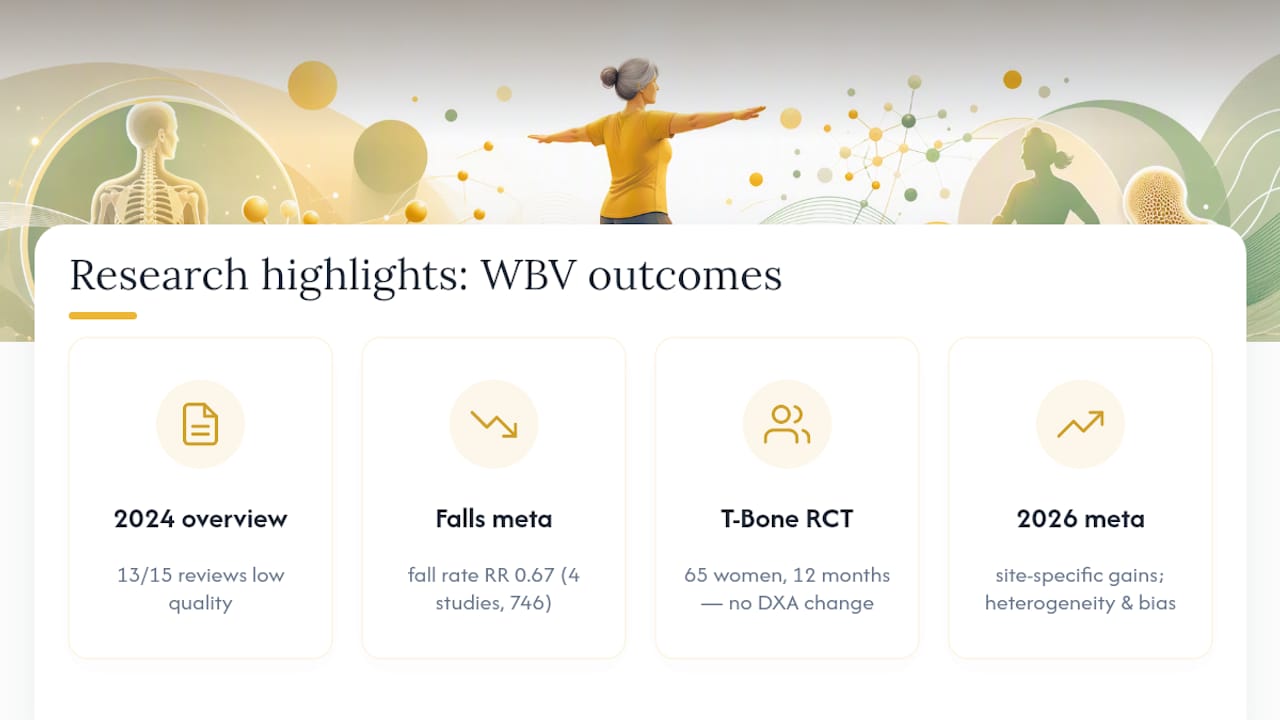
The honest answer is: mixed, and more nuanced than most marketing suggests. A 2024 overview pooling 15 systematic reviews on whole-body vibration and bone mineral density found that 13 of those 15 reviews were rated critically low quality. Its conclusion was blunt: WBV should not currently be recommended specifically to increase bone mineral density, though it may help maintain what patients already have. That distinction between “increase” and “maintain” runs through almost every study in this space.
Fall prevention tells a cleaner story. A 2017 systematic review and meta-analysis of adults over 50 found whole-body vibration training cut fall rate with a rate ratio of 0.67, based on four studies covering 746 participants. The same analysis found no overall effect on bone density or microarchitecture, and fracture data were too sparse to draw conclusions. Fewer falls is a genuinely useful outcome for someone with fragile bones, even when the density scan doesn’t move.
Randomized trials add more texture. The T-bone trial followed 65 postmenopausal women with osteopenia for 12 months of twice-weekly supervised vibration sessions. DXA T-scores showed no significant change compared to controls, though participants gained measurable strength over the year. A shorter 24-week trial found something more encouraging at first glance: a noticeable increase in lumbar-spine BMD in the vibration group. But with only 38 women completing the study, the between-group difference wasn’t statistically significant, and femoral-neck density barely moved.
A 2026 updated meta-analysis pooling 14 studies and 1,447 older adults found improvements at some specific sites, including Ward’s triangle, the greater trochanter, the femoral neck, and the L2 to L4 vertebrae, but not at the total hip or L1 to L4 combined. The authors flagged real heterogeneity and risk of bias across the pooled trials. The pattern that keeps showing up: benefits cluster at certain bones and not others, and they show up more reliably at some study lengths than others.
Bone Density vs. Balance and Strength: Which Result Should You Expect?
Separate the two outcomes in your head, because the research does. Bone density change is slow, small when it happens, and often confined to specific sites like the lumbar spine or Ward’s triangle rather than showing up uniformly across the skeleton.
Functional outcomes are the more dependable win. Multiple trials report gains in muscle strength, improved balance, and a meaningfully lower fall rate, even in studies where bone density stayed flat.
A subset of trials also report improvements in pain and self-reported quality of life, though this evidence is thinner and less consistent than the strength and balance findings. If you’re evaluating a program by asking only “did my T-score go up,” you’re measuring the wrong thing for at least the first six months. Ask instead whether your balance testing, grip strength, or gait speed improved, because those numbers tend to move first and move more reliably.
How Long Before You See Vibration Plate Workout Results?
DXA scans need time to register real change. Most protocols that show any density signal do so between 6 and 12 months, and even then, improvements measured at 6 months don’t always hold up at the 12-month rescan. That’s part of why the T-bone trial’s null result at 12 months isn’t necessarily a contradiction of the 24-week trial’s positive lumbar finding. Different timeframes can genuinely produce different pictures of the same intervention.
Functional measures typically improve more quickly, with gait speed, balance testing, and grip or leg strength often showing gains within weeks of consistent, supervised sessions, well before a bone scan would detect anything. That makes them useful early feedback while you wait for the slower structural changes.
A clinic worth your time should document your baseline DXA, set a defined rescan schedule, log your attendance, and track functional tests alongside the bone scan. Ask what your rescan interval will be before you start.
Who Needs Medical Clearance Before Starting?
Most published trials excluded people with vertebral fractures, joint implants, pacemakers, severe cardiovascular disease, or recent joint replacement. If any of those apply to you, get clearance from your prescribing physician before stepping on a vibration platform. Acceleration levels above 1 g have been flagged as a risk because they can cause loss of contact between the feet and the plate, which is a real hazard for someone with already fragile bones.
Reported adverse effects tend to be mild but worth watching for: dizziness, nausea, and headache during or shortly after sessions. None of these are reasons to panic, but they are reasons to stop and tell staff immediately rather than push through.
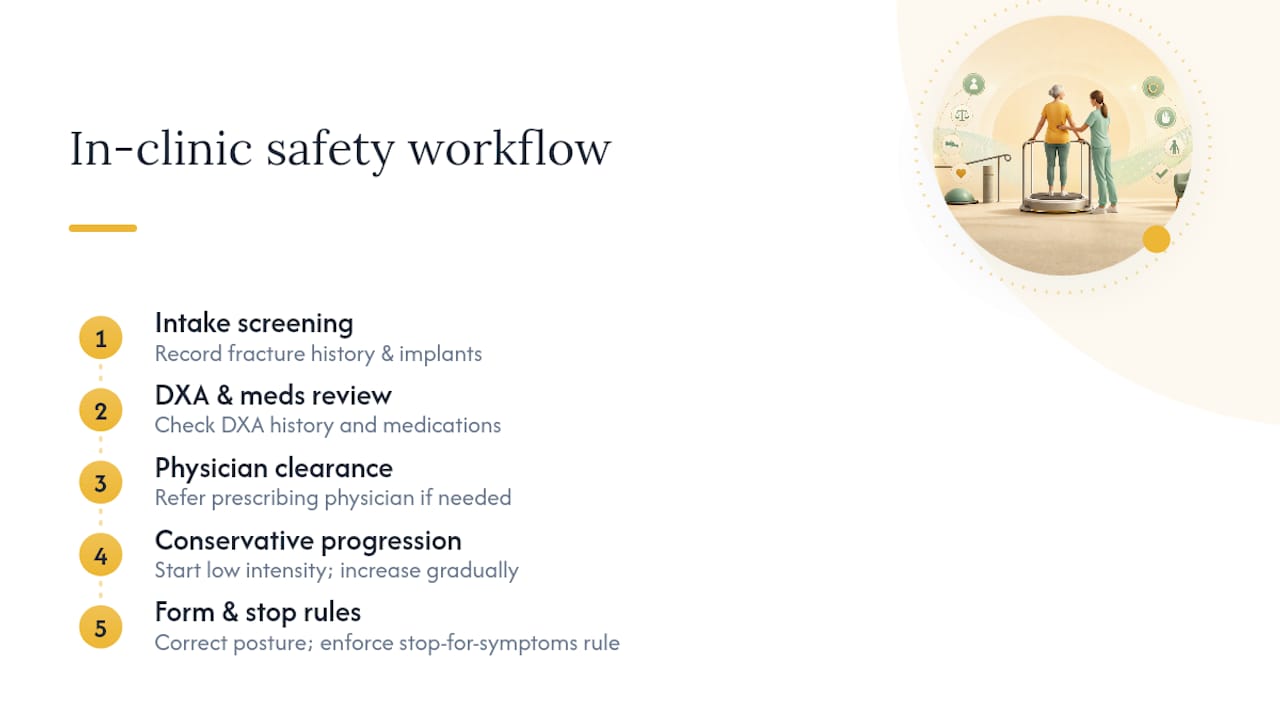
A responsible in-clinic workflow starts with intake covering your DXA history and current medication list, follows a supervised and conservative progression rather than jumping to high settings on day one, corrects posture and knee position throughout, and has a clear stop-for-symptoms rule that staff actually enforce. According to guidance from the National Osteoporosis Guideline Group, clinics should also record fracture history and any implanted devices at intake to properly screen candidates.
How Do You Tell a Credible Vibration Program From a Gimmick?
There’s no single validated vibration prescription for osteoporosis. Trials have used wildly different frequencies, accelerations, postures, and schedules, which is exactly why protocol details matter more than whatever the machine is branded as. One clinical trial protocol, for example, used just 10 minutes daily at 0.3 g and 30 Hz sustained over three years, a far cry from the quick, high-intensity sessions some commercial gyms advertise.
Before committing to a program, ask the clinic to document these specifics:
- Frequency, acceleration in g-force, and amplitude used in your sessions
- Session duration and how the progression plan advances over weeks and months
- Required knee posture and how staff monitor it during sessions
- Baseline and follow-up DXA scheduling, plus functional test tracking (balance, gait, strength)
- Attendance logging tied to your outcome reports
Pro Tip: Ask to see your own numbers in writing, not just a verbal “you’re doing great.” A clinic that can hand you your acceleration setting, your attendance percentage, and your last two DXA comparisons is treating this as medicine. One that can’t is treating it as a gym class.
Walk away from anywhere offering a single, universal protocol regardless of your bone health status, or that refuses to show you the settings you’re actually training at. No documented outcomes and no willingness to discuss parameters are the two clearest red flags in this category.
Does Vibration Plate Therapy Replace Medication or Exercise?
No, and no responsible program will tell you otherwise. Vibration training works best as an adjunct to pharmacologic therapy, progressive resistance training, adequate nutrition, and fall-prevention strategies, not as a substitute for any of them. It tends to be most valuable for patients who can’t tolerate high-impact exercise or who need extra balance support to reduce fall risk. Whatever clinic you choose should be willing to communicate with your prescribing physician and share objective follow-up data rather than operating in isolation from the rest of your care.
An Evidence-First Approach to Osteogenic Loading
One approach to osteogenic loading leans on the same evidence-forward standard this article lays out: measure before you claim results. Sessions can sit alongside red light therapy, PEMF mats, BioCharger sessions, the PureWave VEMI lounge, compression therapy, and hydromassage lounges as complementary support for skeletal and overall wellness. Intake often involves reviewing your latest DXA scan, current medications, and fracture history before building a session plan.
Details on a clinician’s background and specific case outcomes may be available on request.
Ready to Add Supervised Osteogenic Loading to Your Bone Health Plan?
One advantage touted by providers is an evidence-based, non-pharmaceutical protocol built around one brief, supervised session per week, with measurable tracking built into the process rather than bolted on afterward. Where a lot of vibration setups leave you guessing whether anything changed, an osteogenic-loading session is designed to be measured against your own baseline, not a generic average.
If you’re deciding whether this belongs in your bone-health plan, bring your most recent DXA report, your current medication list, and any fracture history to your first visit. That’s what lets staff build a session plan that actually reflects your starting point instead of guessing at it. You can also see how stress and bone density gains get tracked in a weekly clinic model before you commit to a schedule. Book an intake through the Osteostrong landing page to see what a supervised, measured approach looks like for your specific bones.
Sources
This article draws on a 2024 overview of systematic reviews, the T-bone and 24-week randomized trials, a 2017 fall-rate meta-analysis, and a 2026 updated meta-analysis on site-specific bone density changes. Most underlying reviews carry quality limitations the authors themselves flagged.
This article is general information, not a substitute for advice from a qualified doctor. Consult a qualified healthcare professional about your own circumstances before acting on anything here.
- Effects of whole-body vibration on bone mineral density in postmenopausal women: an overview of systematic reviews
- T-bone randomized trial (12-month WBV vs resistance vs control)
- 24-week randomized trial reporting lumbar-spine BMD increase with WBV (2019)
- Meta-analysis showing WBV reduces fall rate but has no overall effect on BMD (2017)
- Updated 2026 meta-analysis: site-specific BMD improvements in older adults
FAQ
Do Vibration Plates Actually Increase Bone Density?
The evidence is mixed and site-specific. Some trials report gains at the lumbar spine or hip subregions like Ward’s triangle, while others, including the 12-month T-bone trial, found no significant overall change. Maintenance of existing density is currently better supported than a reliable increase.
How Long Does It Take to See Vibration Plate Results?
Bone density changes typically take 6 to 12 months to show up on a DXA scan, and results at 6 months don’t always hold at the 12-month rescan. Functional improvements like balance and strength tend to appear sooner, often within weeks of consistent supervised sessions.
Are Vibration Plates Safe for People With Osteoporosis?
They can be, but only with medical screening and supervision. People with vertebral fractures, pacemakers, joint implants, or severe cardiovascular disease need clearance first, and sessions should avoid acceleration above 1 g to reduce the risk of losing contact with the platform.
Can Vibration Therapy Replace My Osteoporosis Medication?
No. It works best as a supplement to pharmacologic treatment, resistance training, and proper nutrition, not a replacement for any of them. Your prescribing physician should stay in the loop on your progress and outcomes.
What Does Osteostrong Charge for a Session?
Current pricing for osteogenic-loading sessions is available directly through the Osteostrong site, since plans vary by location and membership structure.