
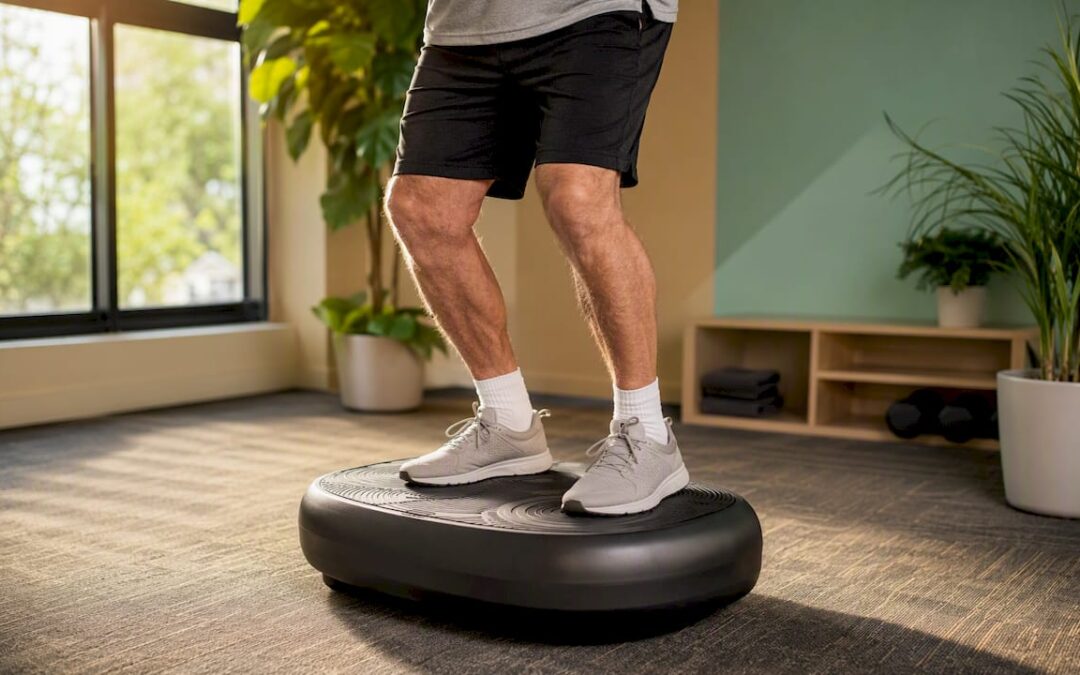
Yes, use a vibration plate before your workout, but treat it as a short activation tool for around several minutes, not a substitute for your normal warm-up. Whole body vibration (WBV) primes muscles through a stretch reflex, nudges circulation upward, and loosens stiff joints, which is exactly what you want before loading a barbell or hitting a run. GoodRx and other sources back short sessions of 5 to 10 minutes, done two to three times a week, rather than daily use. A supervised option like OsteoStrong builds this kind of short vibration exposure into broader sessions rather than treating it as a standalone workout.
Do this now:
- Step on, feet hip-width apart, knees slightly bent, and let the plate run for 30 to 45 seconds before adding movement.
- Move into two or three active exercises (squats, marches, light lunges) for the remaining four to eight minutes, then step off and go straight into your regular training.
Key Takeaways
Short, active vibration plate sessions before training improve circulation and neuromuscular readiness, but they supplement, rather than replace, a real warm-up or resistance training.
| Point | Details |
|---|---|
| Use before, briefly | Run 5 to 10 minutes of active movement on the plate before your workout, not as a standalone session. |
| Match dose to goal | Keep frequency around 20 to 35 Hz with low-to-moderate amplitude for warm-up activation. |
| Move, don’t just stand | Pair the plate with squats, lunges, or marches; passive standing delivers little benefit. |
| Screen for risk factors | Skip or get clearance for pregnancy, DVT, recent surgery, vertigo, or certain implants. |
| Osteostrong integrates it | Osteostrong pairs short supervised vibration exposure with osteogenic loading and other bone-health services rather than using it as a stand-alone workout. |
Table of Contents
- Why a Vibration Plate Can Help Before Training
- Step-by-Step Pre-Workout Protocol on the Plate
- Frequency, Amplitude, and What the Research Actually Shows
- Who Should Skip or Modify Vibration Plate Use
- When a Vibration Plate Is the Wrong Warm-Up Choice
- Building a Sustainable Vibration Plate Routine
- How OsteoStrong Uses Vibration Sessions Alongside Bone-Health Programming
- Get Supervised Vibration Sessions With Your Bone-Health Program
- Sources
Why a Vibration Plate Can Help Before Training
The main benefit isn’t magic, it’s mechanical. Standing on a vibrating platform triggers a rapid stretch reflex in your leg and core muscles, similar to what happens when a doctor taps your knee with a reflex hammer, except it’s firing dozens of times per second. That repeated firing wakes up motor units that a static stretch never touches, which is why Mayo Clinic lists whole body vibration as a legitimate way to boost circulation and mobility before activity.
Three things happen in a good pre-workout session:
- Neuromuscular activation. The tonic vibration reflex recruits muscle fibers faster than voluntary contraction alone, so your stabilizers are already “on” before your first rep.
- Circulation increase. Blood flow rises quickly, which can make joints feel looser within a couple of minutes.
- Brief mobility gains. Hips, ankles, and the lower back often move through a slightly larger range right after a session, useful before squats or deadlifts.
Here’s the part marketing pages tend to skip: standing still on the plate does almost nothing for you. Research summarized by GoodRx notes that real benefit comes from active movement on the platform, not passive standing, and a PLOS One study found more consistent strength and balance results when vibration was paired with active exercise rather than used alone.
Don’t expect fat loss or major calorie burn. WebMD points out that evidence for calorie burn is thin, though one study did find a 2.2% increase in fat-free muscle mass over 24 weeks in a controlled trial. The strongest evidence for vibration plates sits in rehab settings and with older adults working on balance and bone loading. For fat loss or serious muscle building, it’s a supplement to your training, not a replacement for it.
Step-by-Step Pre-Workout Protocol on the Plate
Here’s a routine you can run before almost any training session, from a lifting day to a run.
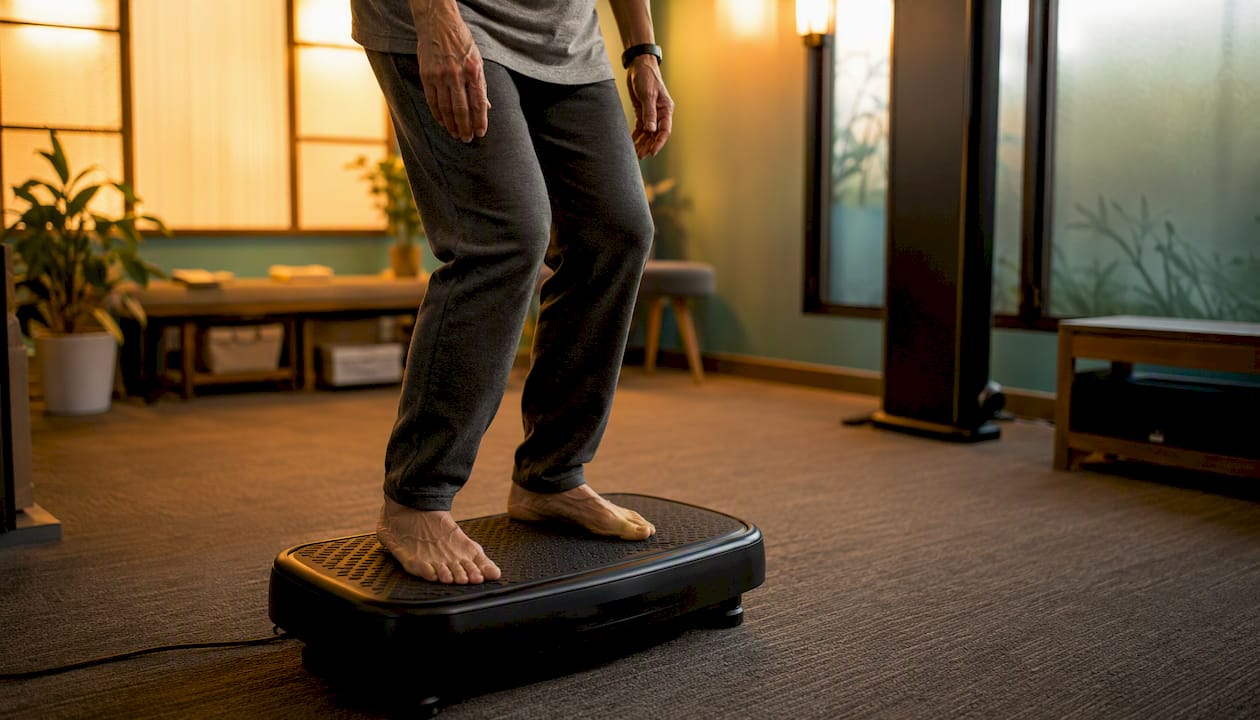
- Step on and settle (30 to 45 seconds). Feet hip-width apart, knees soft, weight centered. Verywell Fit recommends this adjustment window before adding any movement, since your inner ear and stabilizers need a moment to calibrate.
- Marching in place (1 minute). Lift knees to hip height alternately, keeping your core braced. This gets your hip flexors and glutes firing without taxing them.
- Bodyweight squat holds (1 to 2 minutes). Drop into a quarter or half squat and hold for 20 to 30 seconds, rest 10 seconds, repeat three times. This is where the tonic vibration reflex does the most work on your quads and glutes.
- Dynamic lunges (1 to 2 minutes). Alternate forward or lateral lunges, light and controlled, to open up hip mobility before heavier compound lifts.
- Core brace or plank hold (1 to 2 minutes). Hands or forearms on the plate, or feet on the plate in a plank position depending on your model, holding 20 to 30 seconds per set.
| Movement | Time per set | Suggested intensity |
|---|---|---|
| Settling stance | 30 to 45 seconds | Low frequency, low amplitude |
| Marching in place | 30 to 45 seconds | Low to moderate frequency |
| Squat holds | 20 to 30 sec x 3 | Moderate frequency |
| Dynamic lunges | 1 to 2 minutes | Moderate frequency |
| Plank or core brace | 20 to 30 sec x 2 to 3 | Low to moderate frequency |
Posture matters more than people assume. Keep a slight bend in your knees at all times, brace your core like someone’s about to poke your stomach, and breathe normally instead of holding your breath through the vibration. Flat-footed, locked-knee stances transmit more force straight up into your joints, which is uncomfortable and counterproductive.
Pro Tip: Keep the settings on the low-to-moderate end during this warm-up. Cranking the intensity to “feel something” can pre-fatigue the exact muscles you need fresh for your heavy sets, defeating the purpose of a warm-up entirely.
Frequency, Amplitude, and What the Research Actually Shows
Two numbers control everything a vibration plate does to your body: frequency and amplitude. Frequency, measured in hertz (Hz), is how many times per second the plate oscillates. Amplitude, measured in millimeters, is how far it physically moves with each oscillation. Together they form the “dose,” and dose determines whether you get warm-up activation or something closer to rehab-style loading.
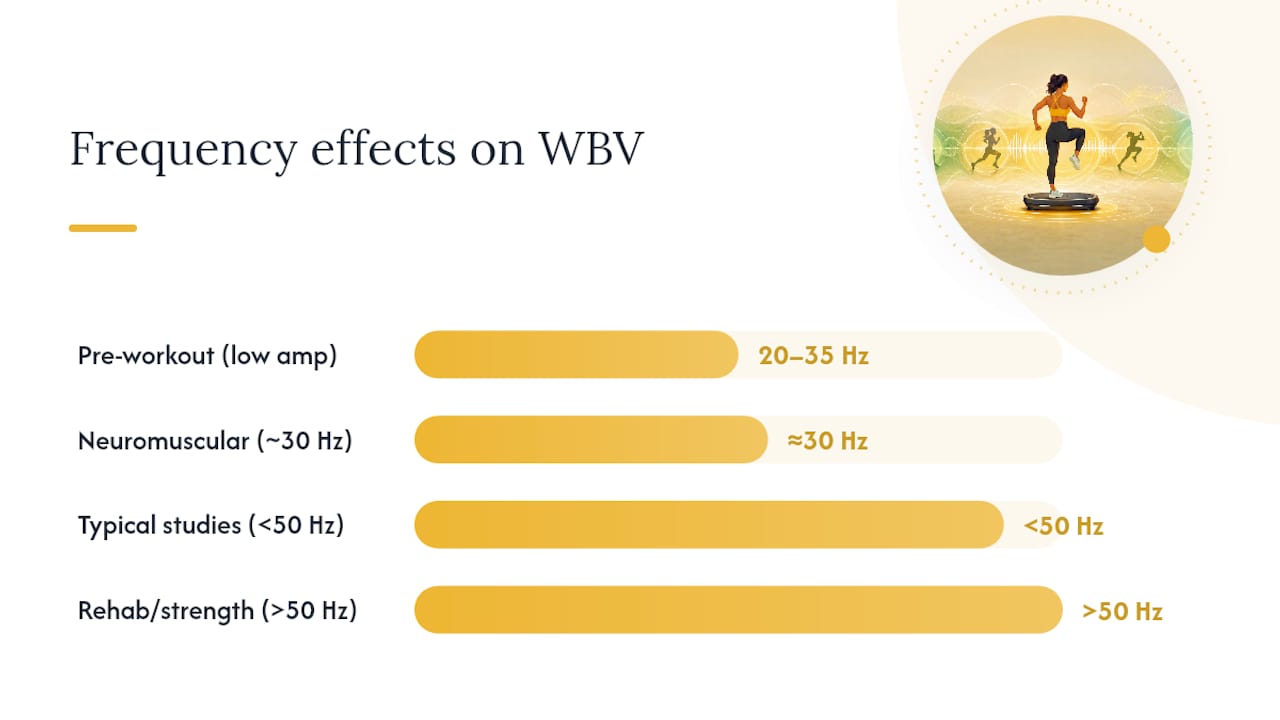
For pre-workout activation, lower frequencies in the roughly 20 to 35 Hz range with low-to-moderate amplitude tend to be the sweet spot. A comprehensive review of whole body vibration research found that most studies use frequencies under 50 Hz, and that the specific combination of frequency, amplitude, and session length changes outcomes substantially, with lower frequencies generally used for rehab and higher ones for neuromuscular activation.
- Frequencies around 30 Hz show up repeatedly in studies looking at neuromuscular activation, which lines up with what you want before a training session.
- Amplitude should stay conservative for warm-ups. Higher amplitude increases the mechanical load transmitted through joints, which is more appropriate for targeted strength work than a quick primer.
- Frequencies above 50 Hz start entering territory better suited to specific rehab or strength protocols under guidance, not casual pre-workout use.
URMC frames the mechanism simply: vibration triggers a stretch reflex and a bump in nitric oxide production, both of which support the “wake up before you work out” effect. The same source calls WBV an exercise mimetic, useful for people with movement limitations, but notes that for most healthy exercisers, traditional resistance training still produces better strength and bone outcomes. That’s a useful reality check. The plate is priming your system, not replacing your squat rack.
Who Should Skip or Modify Vibration Plate Use
Run through this list before you step on the platform, especially if it’s your first time or you have an existing health condition.
- Pregnancy. Vibration exposure during pregnancy isn’t well studied enough to call safe, so skip it unless your obstetrician clears it.
- Recent surgery or acute injury. Healing tissue and hardware don’t need extra mechanical stress on top of recovery.
- Deep vein thrombosis (DVT) or clotting history. Increased circulation is generally a benefit, but with an active clot risk, it’s a conversation for your doctor first.
- Vestibular or inner-ear disorders. Vibration can worsen dizziness or spatial disorientation in people prone to vertigo.
- Certain implants. Some orthopedic hardware and pacemakers may not tolerate vibration transfer well, according to URMC’s clinical notes on contraindications.
- Spinal disc issues. Existing disc problems can flare under repeated mechanical loading.
Stop immediately if you feel dizziness, nausea, new or worsening back pain, or lightheadedness. None of those are “push through it” signals.
Pro Tip: If you fall into any higher-risk category above, get clearance from your physician before your first session, and consider a supervised setting where staff can adjust frequency and amplitude to your specific situation rather than guessing on a home unit.
When a Vibration Plate Is the Wrong Warm-Up Choice
A vibration plate should never be your only warm-up before maximal lifts or high-intensity interval work. Those efforts need elevated heart rate and full range-of-motion movement patterns that a five-minute vibration session doesn’t deliver on its own. Skip it during an acute injury flare-up, and give it a pass right after a large meal if standing vibration makes you queasy.
Better alternatives for those scenarios: a dynamic movement warm-up (leg swings, walking lunges, band work), a few minutes of foam rolling for tight spots, or a short aerobic warm-up like rowing or jogging to raise core temperature. Where a vibration plate still earns its place even without a big lifting session ahead: sedentary people or those with circulation limitations, where standing on a low-intensity plate for a few minutes offers gentle activation they wouldn’t otherwise get.
Building a Sustainable Vibration Plate Routine
A few ground rules keep this useful long-term instead of becoming another gadget collecting dust.
- Start low and short. Begin with lower frequency settings and five-minute sessions before adding time or intensity.
- Pair it with movement. Passive standing wastes most of the benefit; squats, lunges, and marches are where the activation happens.
- Check in after stepping off. If your legs feel shaky rather than warmed up, dial back the intensity next time.
- Don’t go daily on heavy settings. Two to three sessions per week is the commonly cited sweet spot; daily use is fine only for very light mobility work.
Pro Tip: Progress by adding one variable at a time, either a few more minutes, one more exercise in the sequence, or a slightly higher frequency, never all three in the same week.
How OsteoStrong Uses Vibration Sessions Alongside Bone-Health Programming
Inside OsteoStrong centers, vibration plates aren’t the main event. They’re one piece of a supervised session that also includes osteogenic loading, red light therapy, and PEMF mat work, with staff adjusting the vibration component based on each client’s goals and health history.
- Sessions are supervised, so contraindications like vertigo, recent surgery, or implant concerns get flagged before someone steps on the plate.
- Vibration exposure is dosed as a short activation or recovery adjunct, not a stand-alone workout, fitting the same “brief and purposeful” logic covered above.
- Protocols get tailored to bone-health objectives, which matters most for clients managing osteoporosis or osteopenia.
If you want that kind of guided approach rather than guessing at settings on a home unit, an OsteoStrong center session gives you both the vibration component and professional oversight in one visit.
A Practical Take on Short, Supervised Activation
Passive, long sessions on a vibration plate rarely beat a short, purposeful one paired with movement. The clients who get the most out of it are the ones using it as a quick activation tool, not a passive substitute for real training. Brief, supervised use supports readiness. It doesn’t replace the work.
Get Supervised Vibration Sessions With Your Bone-Health Program
If you’ve been doing standalone vibration sessions at a gym and wondering whether you’re dosing frequency and amplitude correctly, that uncertainty disappears with supervision. Osteostrong builds short vibration plate activation into sessions alongside osteogenic loading, red light therapy, and PEMF mat work, so you’re not guessing at settings on your own.
Staff walk you through contraindications, adjust intensity to your goals, and tie the vibration component into a broader bone-health plan rather than leaving it as an isolated gadget session. If you’re managing osteoporosis, osteopenia, or just want proactive skeletal support, book a visit at your nearest OsteoStrong center to see how a supervised session fits your routine.
Sources
- Review: Whole-body vibration dosing and evidence — PMC
- Vibration plates: hot fitness trend — URMC
- Whole-body vibration — Mayo Clinic
- Vibration plates — WebMD
- Vibration plate benefits — GoodRx
Trackbacks/Pingbacks