
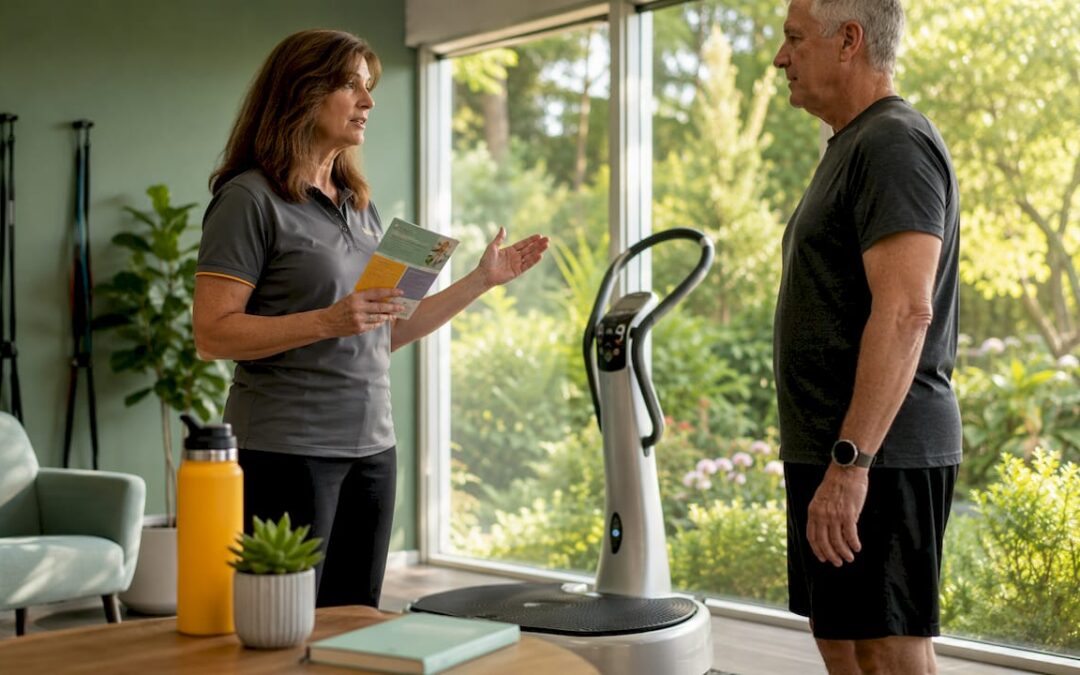
Vibration plates are not safe for everyone. If you have a pacemaker, are pregnant, have acute thrombosis, or recently had joint replacement surgery, you should not use one. The list of absolute contraindications is longer than most fitness marketing suggests, and the consequences of ignoring it range from worsened pain to genuinely serious medical events.
Absolute contraindications for vibration plate use include:
- Pregnancy, especially the first trimester, due to increased joint laxity and circulatory changes
- Pacemakers or any implanted medical devices that may be disrupted by mechanical vibration
- Acute thrombosis or active blood clotting disorders, where increased circulation can dislodge clots
- Recent joint replacement, orthopedic pins, or surgical implants
- Severe cardiovascular disease, including uncontrolled high blood pressure, heart failure, or recent stroke
- Active cancer or tumors
- Uncontrolled epilepsy or active seizure disorders
- Vertigo, dizziness, or inner ear disorders that increase fall risk
- Young children, who lack the musculoskeletal development for safe use
- Elderly individuals with significant frailty or balance instability
The Royal Osteoporosis Society and clinical consensus from multiple peer-reviewed sources align on these categories. If you fall into any of them, stop here and talk to your physician before stepping on a platform.
Table of Contents
- What are the common side effects and risks of vibration plates?
- Which health conditions require medical clearance before use?
- How do machine settings affect vibration plate safety?
- Safe use guidelines and when to stop immediately
- How Osteostrong approaches vibration plate safety in Rancho Cordova
- Neurological and balance disorders: a closer look at vertigo and inner ear conditions
- Osteostrong offers a supervised path to better bone health
- Key Takeaways
What are the common side effects and risks of vibration plates?
Vibration plates are generally safe for most healthy adults when used correctly, but they carry real physiological risks when misused or used by the wrong person. The most commonly reported side effects include temporary dizziness, joint stress, muscle strain, and acute back pain. People with preexisting spinal problems face a sharper risk: back pain and sciatica can worsen significantly, with vibration aggravating lumbar discs and the nerves running through them.
The mechanism is straightforward. Whole-body vibration transmits mechanical energy through your feet, up your skeleton, and into your joints and soft tissue. At higher intensities or longer durations, that energy becomes cumulative stress rather than therapeutic stimulus.
Common vibration plate side effects:
- Temporary dizziness or lightheadedness, especially at higher frequencies
- Joint stress in the knees, hips, or spine when alignment is poor
- Muscle soreness or strain from unaccustomed neuromuscular activation
- Worsening of sciatica or lumbar disc symptoms
- Increased fall risk for those with balance issues
- Excessive use can strain ligaments, muscles, or joints
Pro Tip: Start with sessions of 10 minutes or less at low frequency settings. Your body’s response in the first two or three sessions tells you more than any general guideline.
Which health conditions require medical clearance before use?
Several conditions sit in a gray zone: they are not automatic disqualifiers, but they require a physician’s sign-off before you use a vibration plate. Professional clearance is the primary recommendation for anyone with chronic health issues, recent surgery, or physical instability.
Conditions requiring caution and professional evaluation:
- Blood clotting disorders or clot history: Vibration increases circulation, which can mobilize a clot with dangerous results.
- Osteoporosis (moderate to severe): Severe osteoporosis is a contraindication outright; moderate cases need physician guidance on safe frequency and duration.
- Epilepsy: Vibration can potentially trigger seizures in susceptible individuals.
- Recent surgery or fractures: Any healing tissue, bone, or implant needs time before mechanical loading is appropriate.
- Active cancer or tumors: Increased circulation from vibration may accelerate tumor spread in some cases.
- Eye complications: High-intensity vibration carries rare but documented risks for retinal damage in people with previous eye surgery or retinal vulnerabilities. Anyone who develops flashes, new floaters, or a shadow in their vision after a session should seek urgent eye care.
- Kidney or bladder stones: Vibration can aggravate these conditions.
- Migraines: Vibration may act as a trigger in susceptible individuals.
- Spinal cord injuries: Documented adverse events include pain, pressure sores, and autonomic dysreflexia.
- Severe diabetes with peripheral neuropathy: Reduced sensation makes it harder to detect injury during a session.
- Medications affecting balance or blood pressure: Diuretics, antihypertensives, and vestibular suppressants all alter how the body responds to vibration-induced circulatory and balance changes.
- Children: Their developing musculoskeletal systems are not suited for whole-body vibration platforms.
Age adds its own layer of complexity. Elderly individuals with frailty, reduced bone density, or poor proprioception face a higher fall risk on any vibrating surface, even at low settings.
How do machine settings affect vibration plate safety?

The type of platform and how it is configured changes the risk profile substantially. Two main platform types dominate the market: vertical and rotational (oscillating).
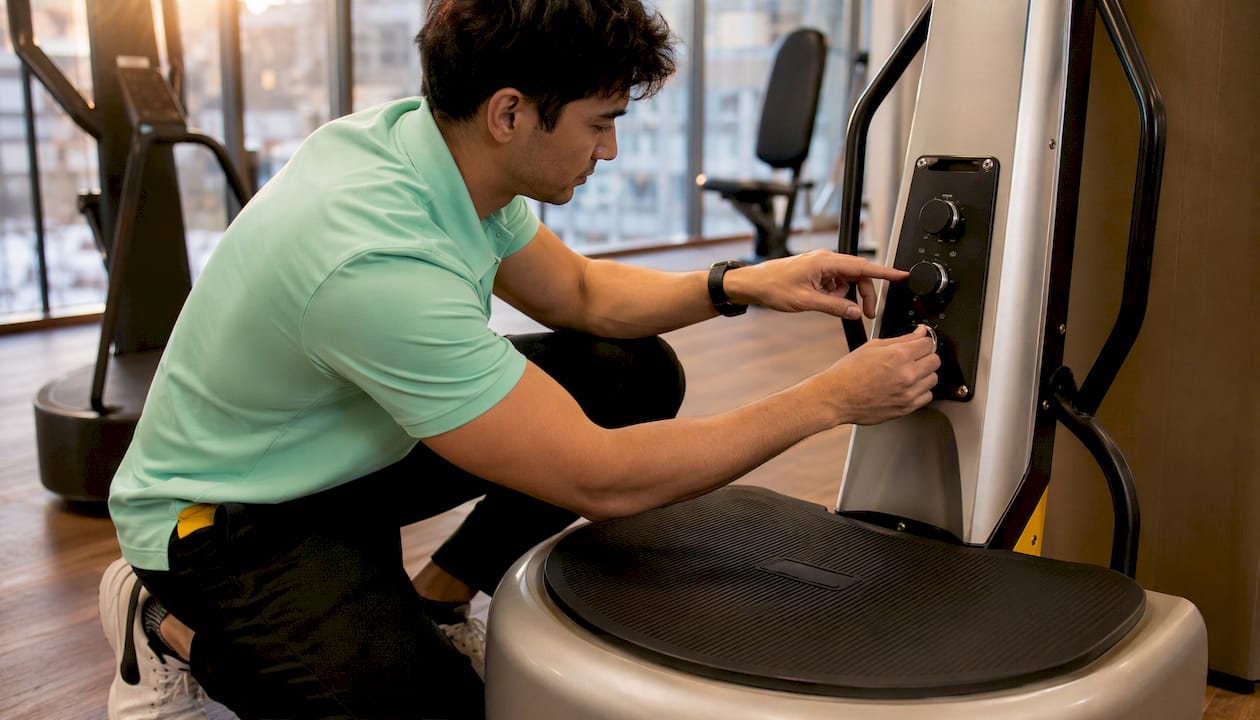
Vertical platforms generate straight up-and-down movement. They tend to be more stable and are widely used in research settings, but they transmit more vibration to the head and upper body. A PMC review found that vertical whole-body vibration transmits 71–189% more vibration to the upper head and body compared to rotational platforms in healthy adults. That makes them a poor choice for anyone with neck pain or vertigo.
Rotational platforms pivot around a central axis, alternating left and right. They transmit less energy to the spine and head, and the same PMC review identified rotational vibration as carrying the lowest adverse effect profile overall. Foot placement on a rotational platform also controls amplitude: wider stance means more movement.
| Setting | Lower Risk | Higher Risk |
|---|---|---|
| Frequency | Below 50 Hz | Above 50 Hz |
| Platform type | Rotational | Vertical (for neck/head sensitivity) |
| Session duration | 10 minutes or less | Extended sessions |
| Amplitude | Low | High |
| User posture | Knees slightly bent (125–130°) | Straight knees |
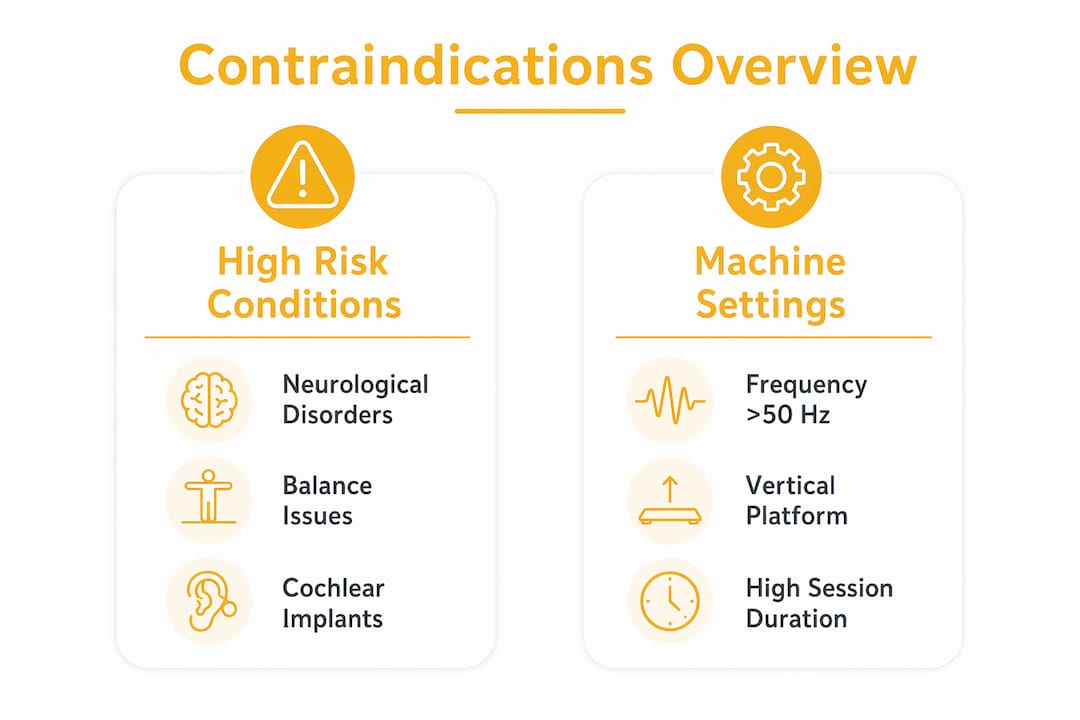
Frequencies above 50 Hz increase the risk of dizziness, falls, and musculoskeletal strain. Keeping knees bent at roughly 125–130 degrees during any session reduces head movement and dampens spinal transmission, regardless of platform type.
Safe use guidelines and when to stop immediately
The Mayo Clinic advises checking with your doctor before using whole-body vibration, particularly if you are pregnant or have any underlying health condition. That recommendation applies broadly, not just to the groups with absolute contraindications.
Practical safety guidelines:
- Get physician or physical therapist clearance if you have any chronic condition, recent injury, or surgery within the past six months.
- Begin with the lowest available frequency and shortest session duration, then increase gradually over several weeks.
- Always maintain a slight knee bend; locking your knees amplifies vibration transmission to the spine and head.
- Avoid vibration plates entirely if you feel unstable or have had a recent fall.
- Stop immediately if you experience chest pain, sudden dizziness, numbness, or worsening pain during or after a session.
- Never use a vibration plate over an area with an open wound, active skin infection, or acute inflammation.
Monitoring your response after each session matters as much as what happens during it. Delayed-onset muscle soreness is normal. Neurological symptoms, joint swelling, or persistent dizziness are not.
How Osteostrong approaches vibration plate safety in Rancho Cordova
At Osteostrong Rancho Cordova, vibration plate use is one component of a broader, supervised wellness protocol, not a standalone fitness gadget. The center’s approach starts with an individual assessment before any therapy begins, which is exactly what clinical consensus recommends for anyone with preexisting conditions.
Osteostrong integrates vibration plates alongside osteogenic loading, red light therapy, PEMF mats, BioCharger sessions, the PureWave VEMI lounge, compression therapy, and hydromassage. That combination matters because bone health and balance improvement rarely come from a single modality. Osteogenic loading, the center’s core offering, stimulates bone growth through brief, high-force loading that is fundamentally different from whole-body vibration and carries its own distinct safety profile.
Pro Tip: If you are managing osteoporosis or osteopenia and want to know whether vibration therapy fits your current bone density and medication profile, bring your most recent DEXA scan results to your first session. It gives the coaching staff a concrete baseline to work from.
The supervised environment at Osteostrong means that contraindications get screened before you ever step on a platform, not after something goes wrong.
Neurological and balance disorders: a closer look at vertigo and inner ear conditions
Neurological and balance disorders represent one of the clearest contraindications in the clinical literature. Individuals with vertigo, dizziness, balance abnormalities, or inner ear disorders face a significantly elevated fall risk on vibration platforms. The vestibular system, which governs balance and spatial orientation, is directly disrupted by whole-body mechanical vibration.
Cochlear implant wearers also fall into this category. The Royal Osteoporosis Society specifically lists cochlear hearing implants as a contraindication, alongside ear problems and active vertigo. Even mild, intermittent dizziness warrants a conversation with a physician before using any vibration platform.
The good news for people with neck pain or mild vestibular sensitivity is that rotational platforms at low frequency and low amplitude carry the lowest side effect profile of any vibration type, according to the PMC clinical review cited earlier. That does not mean they are automatically safe for someone with active vertigo. It means the platform choice and settings matter, and that choice should be made with a clinician, not based on a product description.
Osteostrong offers a supervised path to better bone health
If you have been reading through this list of vibration plate contraindications and wondering whether any of these therapies are actually right for you, Osteostrong in Rancho Cordova is built for exactly that question.
Most wellness centers hand you a machine and a timer. Osteostrong starts with your health history, your bone density data, and your specific goals. The osteogenic loading sessions at the core of the program are designed to trigger bone growth safely, even for people managing osteoporosis or osteopenia who cannot safely use high-intensity vibration. Vibration plates, red light therapy, PEMF mats, and the PureWave VEMI lounge are all available as complementary tools, introduced when they fit your profile.
Visit the Osteostrong Rancho Cordova East location page to book your first session and find out which therapies are appropriate for where you are right now.
Key Takeaways
Vibration plate contraindications cover a wide range of medical conditions, and anyone with a chronic health issue, implanted device, or recent surgery should get physician clearance before use.
| Point | Details |
|---|---|
| Absolute contraindications | Pregnancy, pacemakers, acute thrombosis, recent joint replacement, and active seizure disorders are hard stops. |
| Frequency threshold | Vibration frequencies above 50 Hz increase the risk of injury, dizziness, and musculoskeletal strain. Frequencies of 50 Hz or less are generally lower risk. |
| Platform type matters | Rotational platforms transmit 71–189% less vibration to the head than vertical platforms in healthy adults. |
| Neurological risk | Vertigo, inner ear disorders, and balance abnormalities significantly increase fall risk on any vibration platform. |
| Osteostrong approach | Osteostrong Rancho Cordova screens health history before introducing vibration therapy, pairing it with osteogenic loading for safe bone health support. |