
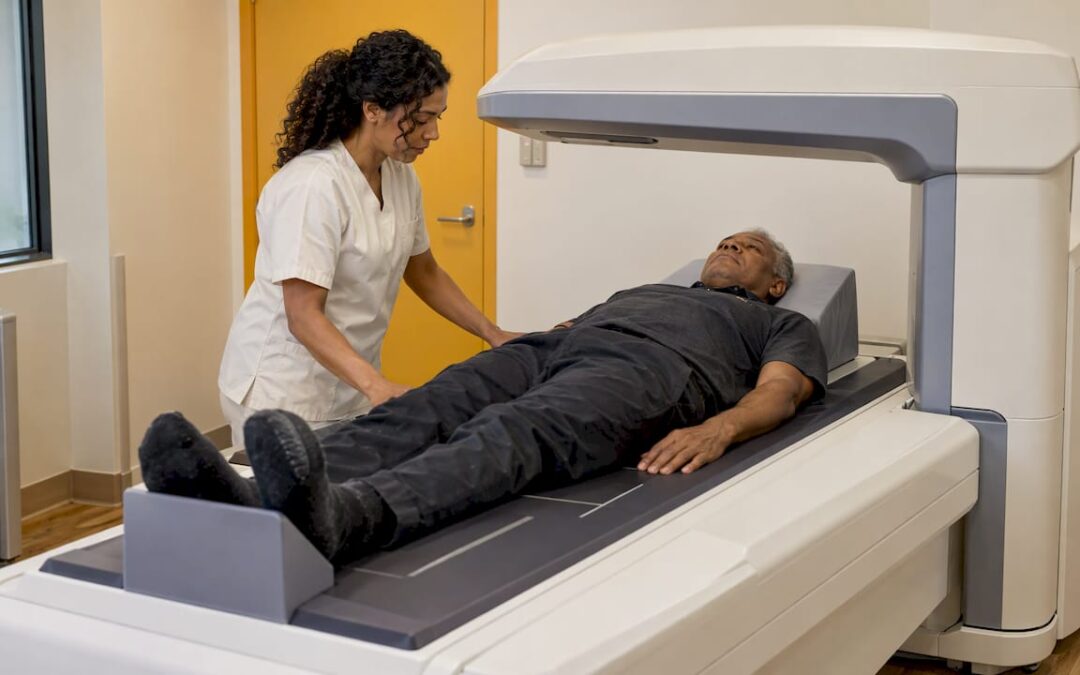
Testosterone helps keep a man’s bones strong, and low levels are linked to lower bone density and more fractures. Testosterone therapy can raise bone density in men who are truly hypogonadal. It is not an approved treatment for osteoporosis, and its effect on fractures is unproven. If you have low testosterone, a bone density (DXA) scan is a sensible next step. Below we walk through what the research says, who should be tested, and what a man can do about his bones alongside his doctor’s plan.
TL;DR
- Low testosterone is associated with reduced bone mass and higher fracture risk in men. Hypogonadism contributes to an estimated 16% to 30% of male osteoporosis cases.
- Testosterone therapy raises bone density in hypogonadal men, mostly at the lumbar spine. The Endocrine Society notes that it is not an approved osteoporosis treatment and that no studies show it lowers fracture risk.
- Men with documented low testosterone, or men diagnosed with osteoporosis, should talk to their doctor about a DXA scan and a hormone workup.
- Mechanical loading, nutrition and medical care work on different parts of the problem. Ask your physician which combination fits you.
Table of Contents
- How testosterone protects a man’s skeleton
- How common is low testosterone in men with weak bones?
- Who should get a bone density test?
- Can testosterone therapy rebuild bone?
- Safety: what to know before starting testosterone
- What else supports men’s bones
- Osteogenic loading for men with osteopenia or osteoporosis
- A practical plan for men with low testosterone
- FAQ
- Sources
How testosterone protects a man’s skeleton
Bone is living tissue. Cells called osteoblasts build it, and osteoclasts break it down. Testosterone influences both sides of that balance.
According to a review of male hypogonadism and osteoporosis, testosterone likely acts on bone directly, through androgen receptors in bone-building cells, and indirectly, because some of it is converted into estrogen. The same review notes that men with aromatase deficiency, who cannot make that conversion, almost universally have osteopenia or osteoporosis. That is a reminder that estrogen matters to men’s bones too.
A 2021 narrative review adds the cellular detail. Testosterone deficiency promotes production of RANKL, a signal that drives osteoclast activity. More RANKL means more bone resorption and lower bone mineral density (BMD). Testosterone also supports growth signals such as IGF-1 in osteoblasts. When levels fall, the brakes on bone loss weaken and the building signals fade.
The link is real but not perfectly tidy. The same 2017 review points out that the connection between hypogonadism and bone loss is not tightly dependent on testosterone levels alone. In the Swedish MrOS cohort, free testosterone correlated with BMD at the hip, femur and arm but not at the lumbar spine, and lower free testosterone was tied to higher fracture risk. Age, genetics, vitamin D, medications and activity all play a part.

How common is low testosterone in men with weak bones?
More common than most men expect. The 2021 narrative review reports:
- In one case-control study, hypogonadism was found in 58% of men with an osteoporotic fracture, compared with 18% of controls.
- In a study of 2,447 community-dwelling older men, osteoporosis was present in 12.3% of men with hypogonadism versus 6.0% of men with normal testosterone.
A 2025 review in the Journal of Clinical Endocrinology & Metabolism states that hypogonadism contributes to 16% to 30% of male osteoporosis cases and is linked to higher fracture risk.
The 2026 review by Kafel and Basaria sums up the picture. In population studies, low testosterone and estradiol are associated with reduced bone mass and more fractures. In men with organic hypogonadism (a clear medical cause, such as testicular or pituitary disease), testosterone replacement produces a robust BMD improvement. In middle-aged and older men with age-related low testosterone, trials show only modest BMD gains, mainly in the spine.
That distinction matters. A 35-year-old with a pituitary problem and a 72-year-old whose levels have drifted down with age are different cases, and the evidence for each is different.
Who should get a bone density test?
Men are often missed. Osteoporosis is thought of as a women’s disease, and fractures in men are, as the European guideline puts it, often overlooked or underestimated.
The guidance from several bodies points the same way:
- The European Academy of Andrology guideline recommends DXA for men with documented hypogonadism and/or testosterone below 200 ng/dL. It suggests DXA for levels between 200 and 300 ng/dL, especially in younger patients or those with symptoms of low testosterone.
- The 2019 European Association of Urology guidelines say young men with testicular dysfunction, and men over 50 with low testosterone, should be screened for osteoporosis.
- In the other direction, an American Family Physician review of osteoporosis in men states that every man diagnosed with osteoporosis should be evaluated for secondary causes of bone loss, including hypogonadism. Initial labs include serum testosterone, vitamin D, calcium, thyroid-stimulating hormone, creatinine, a complete blood count and liver function. The same article notes that up to 40 percent of male osteoporosis cases are primary or idiopathic, meaning no cause is found.
Other risk factors worth discussing with your physician are long-term steroid use, low calcium intake, smoking, heavy alcohol use and certain medications. We cover these in more detail in our guide to osteoporosis risk factors and urgent signs.
How low testosterone is confirmed
A single low reading is not a diagnosis. The 2018 Endocrine Society guideline recommends diagnosing hypogonadism only in men who have symptoms and signs of testosterone deficiency and consistently low serum testosterone. The first test is a fasting morning total testosterone, repeated on a separate morning to confirm. If the total is near the lower limit of normal, or a condition alters sex hormone-binding globulin, a free testosterone is measured too. The European guideline adds that LH and prolactin help characterize the cause, and that vitamin D should be measured at baseline in all hypogonadal men.

Hormone testing is a job for your primary care physician, urologist or endocrinologist.
Can testosterone therapy rebuild bone?
It can raise bone density in the right patient. Whether it prevents fractures is another question, and the honest answer today is that nobody knows yet.
What the trials show
- The Endocrine Society guideline says testosterone therapy in healthy hypogonadal men increases areal and volumetric BMD and bone strength at the spine and hip.
- A meta-analysis of 29 randomized trials covering 1,083 men, described in the 2021 narrative review, found testosterone raised lumbar spine BMD by 3.7% compared with placebo (confidence interval 1.0% to 6.4%).
- A 2022 systematic review of 36 studies and 3,103 people found that placebo-controlled trials showed a positive effect only at the lumbar spine, and only when men were hypogonadal at baseline (total testosterone below 12 nmol/L).
- In a two-year Australian trial in men aged 50 and older, testosterone versus placebo increased tibial cortical volumetric BMD by 3.1% and radial cortical volumetric BMD by 2.9%. The authors say the implications for fracture risk need more study.
What the trials do not show
The Endocrine Society guideline states that there are no studies of testosterone’s effect on fracture risk and that testosterone is not an approved treatment for osteoporosis or for reducing fracture risk.
The largest fracture trial so far adds a complication. The 2025 JCEM review reports that the TRAVERSE Fracture trial unexpectedly found more fractures in treated hypogonadal men than in the placebo group. Most were in the ribs, wrists and ankles, which are not typical osteoporotic sites and may reflect behavior changes on therapy. The Veterans Affairs clinical recommendations also cite a 43% increase in all clinical fractures in a TRAVERSE subtrial. The same document notes that the earlier T-Trials showed increased bone density by volumetric CT.
So bone density can go up while fracture protection stays unproven. The 2025 review concludes that antiresorptive drugs remain first-line treatment for male osteoporosis, and the American Family Physician article names bisphosphonates as the first-line agents, with teriparatide an option for severe cases.
When doctors consider it anyway
The 2012 Endocrine Society guideline on osteoporosis in men suggests testosterone in place of a bone drug for men at borderline high fracture risk whose testosterone is below 200 ng/dL (6.9 nmol/L) on more than one test and who have symptoms of androgen deficiency or organic hypogonadism. If symptoms are not relieved after 3 to 6 months, it advises stopping.
The 2021 narrative review reaches a similar place: testosterone is not recommended solely to maintain BMD in hypogonadal men, but it deserves consideration when a man has hypogonadal symptoms and the goal is to improve symptoms and BMD together.
Safety: what to know before starting testosterone
This is a decision for you and your physician, and the safety rules are specific.
- Who should not start. The Endocrine Society recommends against starting therapy in men planning near-term fertility, or with breast or prostate cancer, a palpable prostate nodule, elevated PSA without urologic evaluation, elevated hematocrit, untreated severe sleep apnea, severe urinary symptoms, uncontrolled heart failure, a heart attack or stroke in the last 6 months, or thrombophilia.
- Blood monitoring. The FDA label for a testosterone product says rising hematocrit, a sign of increased red blood cell mass, may require stopping treatment and may raise the risk of blood clots. It calls for a hematocrit check before starting, about every 3 months in the first year, then every 6 months.
- Cardiovascular questions. The same label describes cardiovascular outcome evidence as inconclusive and notes that some studies have reported more major cardiovascular events. It also warns that abuse at doses above the recommended range can cause serious cardiovascular and psychiatric reactions.
Never take testosterone from an unsupervised source to “fix” bones. Whether to start, and how to monitor, belongs with a physician who has your labs.
What else supports men’s bones
Hormone treatment is one lever. Bone responds to several others, and a man with low testosterone usually benefits from addressing them together with his physician.
- Treat the underlying causes. Because every man diagnosed with osteoporosis should be checked for secondary causes, the workup (vitamin D, calcium, thyroid, kidney and liver function, testosterone) is part of care, not an extra.
- Ask about bone drugs. The medical literature treats antiresorptives as first-line for male osteoporosis. If you are weighing options or cannot tolerate one, our overview of bisphosphonate alternatives explains the landscape to bring to your appointment.
- Review your medications. Long-term steroids are a known cause of bone loss. Acid-suppressing drugs are another topic worth raising; see our summary of PPI-related bone loss.
- Eat for your bones. Calcium and vitamin D intake matter, and some dietary habits work against you. Our practical food guide for osteoporosis covers what to watch.
- Load your skeleton. Bone adapts to the forces placed on it. Impact and resistance work should be matched to your bone status and cleared by your doctor first, and our guide to high impact exercise for osteoporosis explains how that decision is approached.
Mechanical loading is where we work.
Our perspective on loading and low testosterone
Men with low testosterone often hear a single message: fix the hormone. Hormones matter, and we always encourage our members to work with their physician on testing and treatment. But bone does not respond to chemistry alone. It responds to force.
That is the idea behind osteogenic loading. Our protocol is designed to deliver a brief, supervised, high-force session once a week, to signal the skeleton to adapt, using advanced equipment. It is non-pharmaceutical, it is measurable, and it asks for a short visit rather than a daily routine. For a man who has been told his bones are thin and his testosterone is borderline, that is a practical complement to what his doctor is doing, not a replacement for it.
We also like that progress can be tracked. When you can measure the work you are doing, you can talk to your physician about it with data in hand. Our sites around Sacramento also offer red light therapy, PEMF mats, vibration plates and other recovery therapies, so a member’s visit can cover more than one need.
Aaron
Osteogenic loading for men with osteopenia or osteoporosis
At OsteoStrong, our members come once a week for a short, supervised osteogenic loading session designed to stimulate bone growth. We serve adults with osteopenia or osteoporosis, and those who want to be proactive about skeletal health, at our centers in Rancho Cordova, El Dorado Hills and Granite Bay.

If you want to understand how the sessions work before you decide, our pages on osteogenic loading evidence and results from trials and clinics lay out what is known. When you are ready, you can see the osteogenic loading program and find your nearest center. If your DXA scan showed osteopenia, our guide to DXA, FRAX and loading in El Dorado Hills explains how the numbers fit together. Share your plans with your physician first, particularly if you have a fracture history or take bone medication.
A practical plan for men with low testosterone
Putting the research together, here is an order of operations a thoughtful man can bring to his doctor:
- Confirm the diagnosis. Two fasting morning testosterone tests, with free testosterone or SHBG when the numbers are borderline.
- Get a baseline DXA scan. Especially if testosterone is below 300 ng/dL, you are over 50, or you have had a fracture from a minor fall.
- Check the basics. Vitamin D, calcium, thyroid, kidney function, medication review.
- Decide on medical treatment. Discuss whether a bone drug, testosterone therapy for symptoms, or both makes sense, and what monitoring each requires.
- Add what you control. Nutrition, supervised loading and movement, repeated and tracked over time.
- Rescan on your doctor’s schedule. Bone density changes slowly, so judge progress over months, not weeks.
FAQ
Does testosterone increase bone mass in men?
In men with true hypogonadism, yes. Trials show higher bone mineral density, most clearly at the lumbar spine, and one meta-analysis found about a 3.7% gain there versus placebo. In older men with age-related low testosterone, the gains are more modest. Evidence that it prevents fractures is lacking.
Can low testosterone cause osteoporosis in men?
It is a recognized cause. Hypogonadism is estimated to contribute to 16% to 30% of male osteoporosis cases. It is rarely the only factor, so doctors also check vitamin D, calcium, thyroid function and medications.
At what testosterone level should a man get a DXA scan?
The European Academy of Andrology guideline recommends a scan for documented hypogonadism and/or levels below 200 ng/dL, and suggests one between 200 and 300 ng/dL, especially in younger men or those with symptoms. Men over 50 with low testosterone should also be screened, according to European urology guidelines.
Is testosterone therapy an approved osteoporosis treatment?
No. The Endocrine Society states that testosterone is not an approved treatment for osteoporosis or for reducing fracture risk. Antiresorptive drugs remain the first-line approach for male osteoporosis. Your physician may still use testosterone to treat symptomatic hypogonadism, with regular blood monitoring.
Sources
- Male Hypogonadism and Osteoporosis: The Effects, Clinical Consequences, and Treatment (PMC, 2017)
- Testosterone and Bone Health in Men: A Narrative Review (PMC, 2021)
- Testosterone and Male Bone Health: A Puzzle of Interactions (JCEM, 2025)
- Testosterone and Bone Health in Men (PubMed, 2026)
- EAA clinical guideline on management of bone health in the andrological outpatient clinic
- EAU Guidelines on Male Hypogonadism (2019)
- Osteoporosis in Men (American Family Physician)
- Testosterone Therapy in Men With Hypogonadism: An Endocrine Society Clinical Practice Guideline (2018)
- Osteoporosis in Men: An Endocrine Society Clinical Practice Guideline (2012)
- Testosterone supplementation and bone parameters: a systematic review (PubMed, 2022)
- Effect of Testosterone Treatment on Bone Microarchitecture and Bone Mineral Density in Men (PubMed, 2021)
- VA clinical recommendations on testosterone replacement therapy (January 2026)
- FDA prescribing information for a testosterone product (2022)