

Supervised, in-person therapies — osteogenic loading, structured resistance programs, and select adjunct modalities — can meaningfully complement bisphosphonates and, in closely supervised cases, partially substitute them. But they rarely replace prescription care outright without clinician coordination. Before you change or stop any medication, talk to your prescribing clinician and a bone-health specialist. That step is not optional. The ASBMR/BHOF 2024 task force is explicit: treatment must be individualized based on fracture history, BMD, and risk profile. Stopping denosumab without a planned follow-on medication carries a documented rebound fracture risk that no in-person therapy can offset. Osteostrong’s supervised osteogenic loading sessions are a leading non-pharmacological option in the US, but they work best as part of a coordinated plan, not a unilateral swap.
Table of Contents
- What in-person, non-drug therapies are available for bone density?
- How do these therapies work differently than bisphosphonates?
- What does the clinical evidence actually say?
- What are the real safety risks of stopping medication?
- How do you trial in-person therapy safely?
- How do you coordinate in-person therapy with your medical team?
- Key Takeaways
- Why supervised loading deserves more credit than it gets
- Start your supervised bone-health program at Osteostrong
- Useful sources and further reading
What in-person, non-drug therapies are available for bone density?
These are the supervised, clinic-delivered options worth knowing:
- Osteogenic loading: High-force, short-duration mechanical loads applied through specialized equipment in clinic sessions. Osteostrong’s weekly sessions use this approach to stimulate bone adaptation through mechanotransduction.
- Progressive resistance and weight-bearing exercise: Supervised programs with a physical therapist or exercise physiologist, targeting the hip, spine, and wrist — the fracture-prone sites.
- Whole-body vibration platforms: Clinic-grade devices that deliver oscillatory stimulation; used as an adjunct, not a standalone therapy.
- Pulsed electromagnetic field (PEMF) therapy: Delivered via mats or pads in supervised sessions; thought to support cellular bone metabolism.
- Red light / near-infrared therapy: Clinic devices used as an adjunct to loading; red light therapy for bone density is an emerging area with growing interest.
- Balance and fall-prevention physical therapy: Reduces fracture risk indirectly by improving neuromuscular control and reaction time.
- Recovery adjuncts: Compression therapy, hydromassage lounges, and BioCharger sessions are often paired with osteogenic loading to support recovery and overall wellness.
How do these therapies work differently than bisphosphonates?
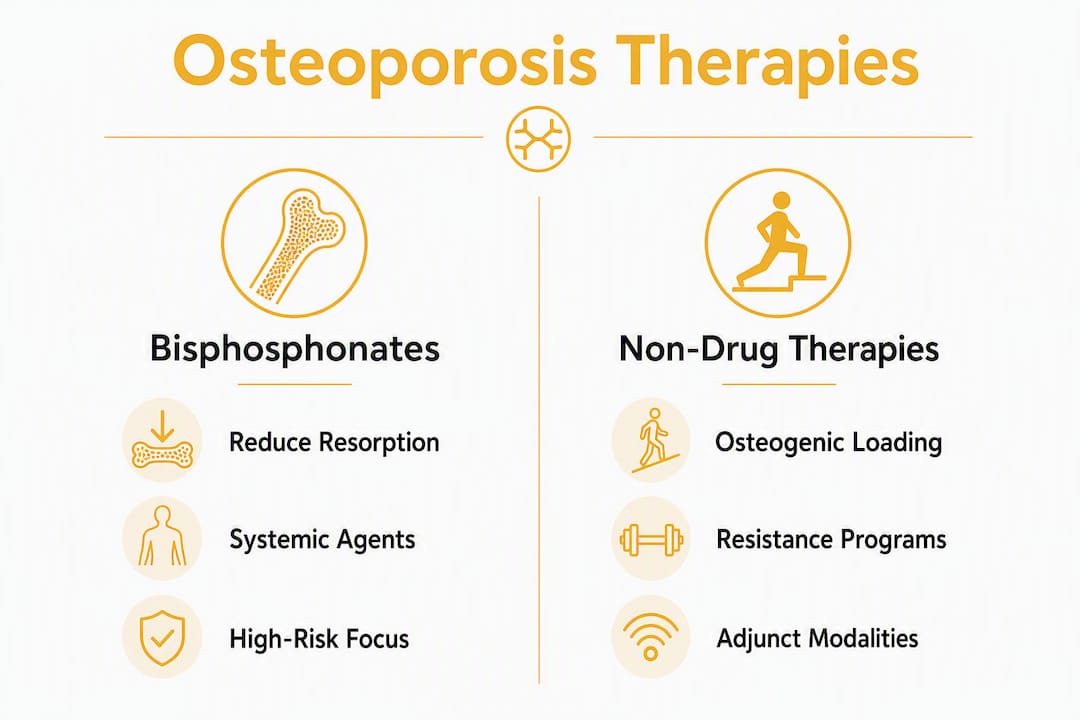
Mechanical loading signals bones to adapt locally — the stimulus travels through the skeleton at the loaded site, triggering osteoblast activity and architecture changes. Bisphosphonates and denosumab work systemically: they circulate through the bloodstream and act on bone remodeling pathways throughout the body, either inhibiting osteoclasts (bisphosphonates) or blocking RANKL signaling (denosumab). The two approaches target different biology.
The core difference: Mechanical therapies drive local bone formation through load-driven mechanotransduction. Bisphosphonates and denosumab reduce systemic bone resorption through cellular signaling. One builds; the other brakes. Both can improve bone mineral density (BMD), but through entirely different pathways — which is exactly why they can work together.
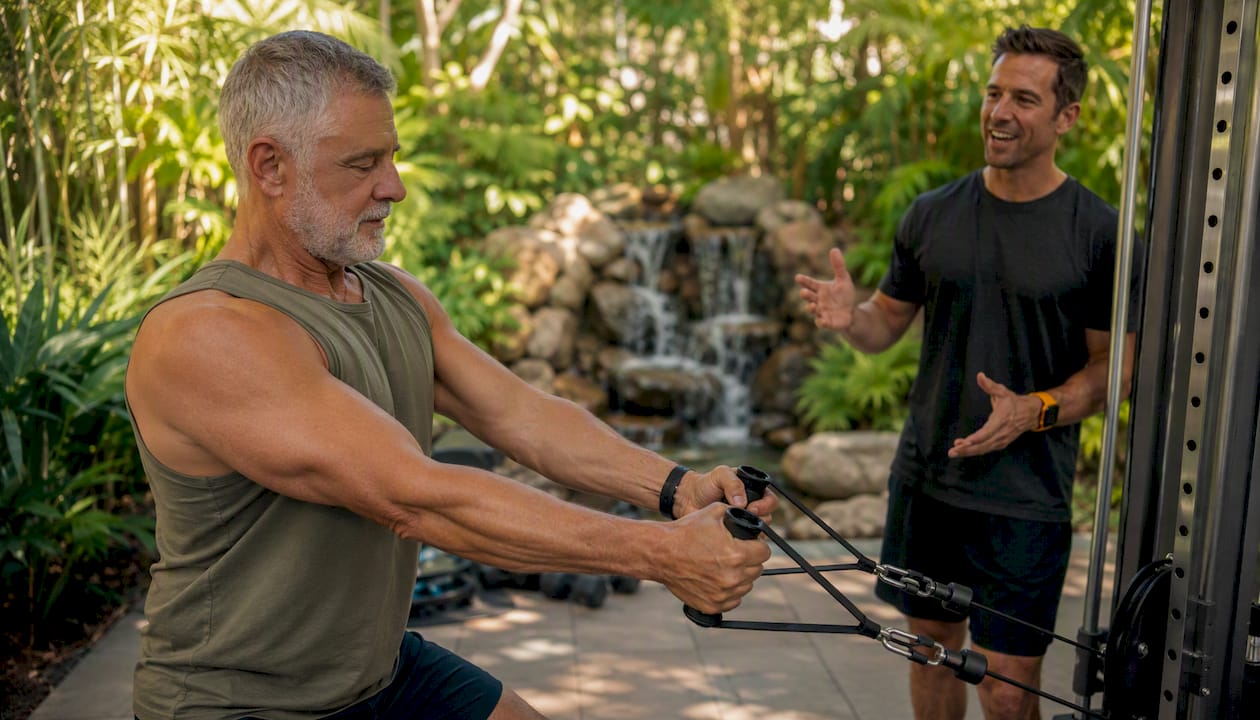
That distinction matters practically. A weekly osteogenic loading session at a clinic like Osteostrong can strengthen the hip and spine by applying forces that exceed what most daily activities generate. What it cannot do is replicate the systemic, whole-skeleton remodeling suppression that an antiresorptive medication delivers. Onset also differs: functional improvements from loading can appear within weeks; measurable BMD changes on DXA typically take 6–12 months regardless of the intervention.
What does the clinical evidence actually say?
The honest answer: the fracture-reduction evidence for prescription antiresorptives is stronger and more consistent than for most in-person modalities. That is not a reason to dismiss non-pharmacological options. It is a reason to use them with clear eyes.
The ASBMR/BHOF 2024 task force recommends individualized treatment selection and explicitly favors osteoanabolic agents — teriparatide, abaloparatide, romosozumab — for patients with recent major fractures or very low BMD, because they rebuild bone faster than antiresorptives.
Evidence by modality, in plain terms:
- Osteogenic loading / resistance exercise: Moderate-to-strong evidence for BMD improvement at loaded sites and for reducing fall risk. NHS guidance recognizes supervised mechanical loading as a legitimate non-drug complement to medical care.
- Whole-body vibration: Limited evidence; results are inconsistent across trials. Best used as an adjunct.
- PEMF: Emerging evidence, mostly in smaller studies. Promising for cellular bone metabolism but not yet guideline-endorsed as a standalone therapy.
- Red light / near-infrared: Early-stage evidence; no major guideline body has issued a formal recommendation yet.
- Balance and fall-prevention PT: Strong indirect evidence — fewer falls means fewer fractures, which is the outcome that matters most.
Harvard Health notes that non-drug therapies rarely fully replace systemic agents for high-risk patients, particularly those with a T-score below -2.5 and a prior fragility fracture.
What are the real safety risks of stopping medication?
Do not stop denosumab without a clinician-planned transition. Full stop. Clinical guidance documents rapid BMD loss and a sharply elevated risk of multiple vertebral fractures within months of cessation without a follow-on medication. This is not a theoretical risk — it has been reported in real patients who felt well and decided to pause.
Bisphosphonates behave differently on discontinuation. Because they bind to bone mineral, residual effects can persist for years after stopping, which gives clinicians more flexibility for planned “drug holidays.” Denosumab has no such reservoir effect.
Critical warning: Transitioning off denosumab requires a planned follow-on medication — typically a bisphosphonate — to prevent rapid bone loss. Medfinder’s clinical commentary and the ASBMR/BHOF task force both flag this as one of the most dangerous and underappreciated gaps in patient self-management.
Red flags and contraindications for in-person modalities:
- Recent fragility hip or spine fracture: high-force osteogenic loading requires medical clearance first.
- Unstable cardiovascular disease: consult your cardiologist before starting any high-intensity loading program.
- Active infection or open wounds: defer clinic sessions.
- Certain implanted electronic devices (pacemakers, spinal cord stimulators): check device labeling before PEMF or red light sessions. See PEMF therapy side effects for a detailed contraindication list.
Pro Tip: Before your first clinic session, ask whether staff review your DXA results and fracture history, and whether they communicate with your prescribing clinician. A facility that skips that intake step is one to reconsider.
How do you trial in-person therapy safely?
A supervised trial typically runs 8–24 weeks before you can detect functional trends, and 6–12 months before DXA shows measurable BMD change. Plan accordingly.
What a first visit should include:
- Medical intake form covering fracture history, current medications, and DXA date
- Review of contraindications for each modality offered
- Baseline balance and functional movement assessment
- Supervised demonstration of the loading equipment at low force before full sessions begin
Questions to bring to your first provider conversation:
- Do you coordinate with my prescribing clinician or bone-health specialist?
- What are the contraindications for each therapy you offer?
- What are your staff credentials (PT, exercise physiologist, certified technician)?
- How often will I need to come, and for how long before we assess progress?
- What does monitoring look like — DXA, bone markers, or functional tests?
- What are the session and membership costs, and does insurance cover any PT-supervised components?
| Therapy | Typical frequency | Time to functional change | Time to DXA change | Cost range |
|---|---|---|---|---|
| Osteogenic loading | Once weekly | 4–12 weeks | 6–12 months | Membership-based; varies by location |
| Supervised resistance PT | 2–3x weekly | 4–8 weeks | 6–12 months | Insurance may cover PT visits |
| Whole-body vibration | 2–3x weekly | Variable | 6–12 months | Often bundled with clinic membership |
| PEMF sessions | 2–5x weekly | Variable | Not well established | Session or membership fee |
| Balance/fall-prevention PT | 1–2x weekly | 4–8 weeks | Indirect (fall reduction) | Insurance may cover |
Pairing loading sessions with adequate protein intake supports muscle and bone adaptation. Post-workout protein synthesis is a well-documented anabolic response that applies to bone-adjacent muscle tissue as well.
How do you coordinate in-person therapy with your medical team?
Always loop in your prescribing clinician before starting an intense loading program, and before making any medication change.
- Confirm your DXA baseline. Know your current T-score and when your next scan is scheduled before you start any new therapy.
- Share your fracture history. Recent fragility fractures change the risk calculus for high-force loading and for medication decisions.
- Request a written transition plan if you are considering stopping or switching an injectable medication, especially denosumab.
- Schedule baseline measurements before your first loading session so you have a clean comparison point at 6 and 12 months.
- Set a monitoring cadence. DXA is typically repeated every 1–2 years; bone turnover markers can be checked sooner to detect early response or rebound.
- Know the escalation trigger. Per ASBMR/BHOF guidance, rapid BMD loss or a new fracture while on a non-drug program is a signal to move to osteoanabolic therapy without delay.
Key Takeaways
Non-pharmacological, in-person therapies can meaningfully support bone density, but they complement rather than replace prescription care for most adults with osteoporosis or osteopenia.
| Point | Details |
|---|---|
| Clinician coordination is required | Never stop denosumab or bisphosphonates without a planned transition; rebound fracture risk is real. |
| Mechanism differs from medication | Osteogenic loading drives local bone formation; antiresorptives suppress systemic resorption — both can improve BMD. |
| Evidence varies by modality | Resistance exercise and osteogenic loading have the strongest non-drug evidence; PEMF and red light are adjuncts. |
| Timeline is measured in months | Expect 6–12 months for DXA-measurable BMD change; functional gains can appear sooner. |
| Osteostrong offers supervised osteogenic loading | Weekly sessions plus PEMF, red light, vibration, and recovery therapies make it a leading in-person option in the US. |
Why supervised loading deserves more credit than it gets
Most conversations about non-pharmacological bone health get stuck in the same place: “exercise is good, but it’s not a drug.” That framing undersells what supervised osteogenic loading actually does and overstates what it cannot do.
The honest clinical picture is more interesting. Bisphosphonates reduce resorption reliably, but they do not build new bone architecture. Osteogenic loading does — at the loaded sites, through a stimulus most people never generate in daily life. The two approaches are not competing; they are addressing different parts of the same problem. What frustrates me about the conventional framing is that it treats “not a drug” as a weakness rather than a feature for patients who have legitimate reasons to minimize systemic medication exposure.
That said, the safety caveat is real and non-negotiable. Patients who stop denosumab without a follow-on plan because they feel better or want to “go natural” are taking a risk that no amount of weekly loading sessions can offset. The rebound fracture data is not ambiguous. The right move is to add supervised loading to a coordinated plan, not to use it as an exit ramp from medication without medical oversight.
Start your supervised bone-health program at Osteostrong
If you want a supervised, evidence-informed option that goes beyond a gym membership, Osteostrong delivers weekly osteogenic loading sessions designed specifically for adults with osteoporosis and osteopenia. Each session uses specialized equipment to apply forces that stimulate bone adaptation at the hip, spine, and wrist — the sites that matter most for fracture prevention. Beyond loading, Osteostrong locations offer red light therapy, PEMF mats, vibration platforms, compression therapy, and hydromassage lounges, all under one roof.
What to bring to your first visit: your most recent DXA report, a list of current medications (including any bisphosphonates or injectables), your fracture history, comfortable clothing and supportive shoes, and your prescribing clinician’s contact information. Staff will review your intake before your first session.
Find an Osteostrong location near you and book a consultation. If you are exploring what osteogenic loading looks like outside a clinic setting, the osteogenic loading at home guide is a practical starting point.
Useful sources and further reading
“Goal-directed treatment should individualize therapy; osteoanabolic agents are preferred for patients with recent major fractures and very low BMD.” — ASBMR/BHOF 2024 Task Force Position Statement
- ASBMR/BHOF 2024 Task Force Position Statement on Goal-Directed Osteoporosis Treatment
- Osteoporosis Treatment — Mayo Clinic
- Osteoporosis Treatment — NHS
- Osteoporosis Drugs: Which One Is Right for You? — Harvard Health
- Alternatives to Alendronate If You Can’t Fill Your Prescription — Medfinder
- Medicines for Osteoporosis — UF Health
- Red Light Therapy for Bone Density — Bone Health Sacramento
- High Impact Exercise for Osteoporosis — Bone Health Sacramento
This article is general health information, not medical advice. Confirm current treatment guidelines and medication decisions with your prescribing clinician or a qualified bone-health specialist.