

The biggest osteoporosis risk factors fall into five buckets: being an older woman past menopause or a man over 70, having a small body frame, carrying a family history of hip fracture, living with certain medical conditions or taking bone-thinning medications long-term, and lifestyle gaps like low calcium, low activity, smoking, or heavy drinking. Three signals demand prompt evaluation, not a wait-and-see approach: a recent low-trauma fracture, noticeable height loss or new stooping, and long-term glucocorticoid use. A DXA scan combined with the FRAX calculator is how clinicians turn these risk factors into an actual number.
TL;DR:
- Women past menopause and men over 70 are at the highest risk, especially if they have a small body frame, family history, or engage in risky lifestyle behaviors like smoking or heavy drinking.
- A recent low-trauma fracture, significant height loss, or long-term glucocorticoid use are urgent signals requiring immediate evaluation through DXA and FRAX risk assessment tools.
- Medical conditions such as hormonal disorders and certain medications like steroids or aromatase inhibitors significantly increase bone loss risk, especially with prolonged dose and duration.
- Lifestyle factors like low calcium, vitamin D, protein intake, physical inactivity, smoking, and heavy alcohol use directly weaken bones and raise fracture risk, especially when combined.
- Early screening based on individual risk factors is crucial, with women under 65 needing assessment if they have prior fractures, family history, or secondary causes, and men only if additional high-risk conditions exist.
Table of Contents
- Who Is at Higher Risk for Osteoporosis?
- Which Medical Conditions and Medications Raise Osteoporosis Risk?
- What Lifestyle Factors Increase Osteoporosis Risk?
- When Should You Get an Osteoporosis Risk Assessment?
- How Do You Reduce Osteoporosis Risk and Prepare for a Doctor Visit?
- A Clinician-Forward Take on Bone Risk
- How Osteostrong Fits Into a Bone-Health Plan
- Sources
- FAQ
Who Is at Higher Risk for Osteoporosis?
Age and sex do most of the heavy lifting here. Women lose bone fastest in the five to seven years after menopause, when falling estrogen levels accelerate bone breakdown faster than the body can rebuild it. Men are not exempt. Risk climbs meaningfully after age 70, and clinicians often under-assess men because osteoporosis still gets coded as a “women’s disease” in a lot of clinical thinking.
Body frame matters more than most people realize. Someone with a smaller, thinner skeletal frame simply has less bone mass to lose before crossing into fracture territory, and unexplained height loss of an inch and a half or more is a practical, visible clue that vertebrae are compressing.
Genetics load the dice without sealing your fate. Family history raises risk, especially a parent’s hip fracture, because inherited peak bone mass interacts with your own hormones, medications, and health conditions over a lifetime. Race and ethnicity add nuance, too. White and Asian individuals show higher documented rates in U.S. data, but that does not mean other groups are immune. It means screening decisions should never rest on ethnicity alone.
A few practical flags worth remembering:
- A parent’s hip fracture history should trigger an earlier risk conversation, not a “wait until 65” default.
- Height loss of 1.5 inches or more since your tallest adult height deserves a clinical look.
- Small body frame plus low body weight compounds the age and sex risk rather than sitting separately from it.
Which Medical Conditions and Medications Raise Osteoporosis Risk?
Osteoporosis often has a secondary cause hiding behind it, and finding that cause changes treatment. Merck Manual frames bone loss as a breakdown in one of three processes: you never built enough peak bone mass, your body is breaking down bone too fast, or it is not forming new bone fast enough. Endocrine disorders (hyperthyroidism, hyperparathyroidism), inflammatory bowel disease and celiac disease, rheumatoid arthritis, chronic kidney or liver disease, and certain blood cancers all tip that balance.
Medications are just as important to flag. Long-term glucocorticoids, aromatase inhibitors used in breast cancer treatment, androgen-deprivation therapy for prostate cancer, some anticonvulsants, heparin, proton pump inhibitors, SSRIs, and thiazolidinediones have all been linked to bone loss. Risk depends heavily on dose and duration. A short course of prednisone for a sinus infection is not the same exposure as three years of daily steroids for lupus.
- Endocrine: hyperthyroidism, hyperparathyroidism, uncontrolled diabetes
- GI/autoimmune: celiac disease, inflammatory bowel disease, rheumatoid arthritis
- Medications: glucocorticoids, aromatase inhibitors, androgen-deprivation therapy, some anticonvulsants, PPIs, SSRIs, thiazolidinediones
- Red flags: prior fragility fracture, prolonged bed rest or immobilization, early menopause or amenorrhea
Pro Tip: Write down every medication name, dose, and the date you started it before your appointment. “I’ve been on prednisone for a while” tells a clinician far less than “10 milligrams daily since March 2023.”
What Lifestyle Factors Increase Osteoporosis Risk?
Diet and movement are where you actually have leverage. Chronically low calcium and vitamin D intake, or a malabsorption condition like celiac disease or a history of bariatric surgery, starves bone-building of the raw material it needs. Protein deficiency compounds the problem since bone is roughly half protein by volume.
Movement matters just as much as diet. Weight-bearing exercise, walking, stair climbing, resistance training, signals bone to stay dense; prolonged inactivity, whether from a desk job or an extended illness, does the opposite. Smoking directly interferes with bone-building cells, and heavy alcohol use both blocks calcium absorption and raises fall risk.
- Low calcium, vitamin D, or protein intake, especially with a malabsorption condition
- Sedentary lifestyle or extended bed rest
- Smoking, at any amount, and heavy alcohol consumption
- Eating disorders, very low BMI, or amenorrhea (missed periods) in younger women
That last point deserves its own callout. A young woman with an eating disorder or exercise-induced amenorrhea can have bone density comparable to someone decades older, because low estrogen combined with nutritional deficits hits bone remodeling from two directions at once.
When Should You Get an Osteoporosis Risk Assessment?
The USPSTF’s 2025 guidance recommends DXA screening for all women 65 and older. For postmenopausal women younger than 65, the recommendation is to run a risk-assessment tool first and screen only those who come back elevated. Evidence still is not strong enough to recommend routine population screening in men, which is exactly why individual judgment matters for men with fractures or known risk exposures.
A DXA scan produces a T-score, comparing your bone density to a healthy young adult, or a Z-score, comparing it to people your own age and sex. The Z-score matters more in younger patients or when a secondary cause is suspected. FRAX then folds your age, weight, fracture history, family history, and other clinical factors, with or without a BMD result, into a 10-year fracture probability.
U.S. treatment decisions commonly consider estimated 10-year hip or major osteoporotic fracture risks at certain thresholds, interpreted with the full clinical context.
Testing earlier than the standard age cutoff makes sense if you have had a fragility fracture, a parent with a hip fracture, long-term use of a high-risk medication, or a condition tied to secondary bone loss.
- Prior low-trauma fracture at any age
- Parental hip fracture history
- Long-term glucocorticoid or other high-risk medication use
- Any diagnosed secondary cause listed above
It is worth separating two related but distinct ideas: osteoporosis is a bone-density diagnosis, while fracture risk is a broader calculation that includes falls and prior breaks independent of what the scan shows. Someone with borderline bone density but two prior fractures may carry more real-world risk than someone with a lower T-score and no fracture history.
How Do You Reduce Osteoporosis Risk and Prepare for a Doctor Visit?
Fracture risk is highest in the one to two years right after a fracture, which is exactly why a recent break deserves urgent follow-up rather than a routine callback in six months.
- Start weight-bearing and resistance exercise, along with balance training, after clearing it with your clinician.
- Quit smoking and keep alcohol intake moderate. Both directly undermine bone quality.
- Review calcium and vitamin D intake with a clinician rather than guessing at supplement doses.
- Never stop a prescribed medication on your own, even one linked to bone loss. Bring a full, dated medication history to your appointment instead.
- Address fall risks at home. Loose rugs, poor lighting, and unstable footwear cause more fractures than people expect.
Pro Tip: If you’ve had a fracture from a fall that shouldn’t have caused one, a specialist referral, not just a repeat scan, is usually the right next step. Seek out a bone specialist directly if you have had a recent fracture, a very low BMD result, or a secondary cause that a general practitioner is not equipped to manage alone.
A Clinician-Forward Take on Bone Risk
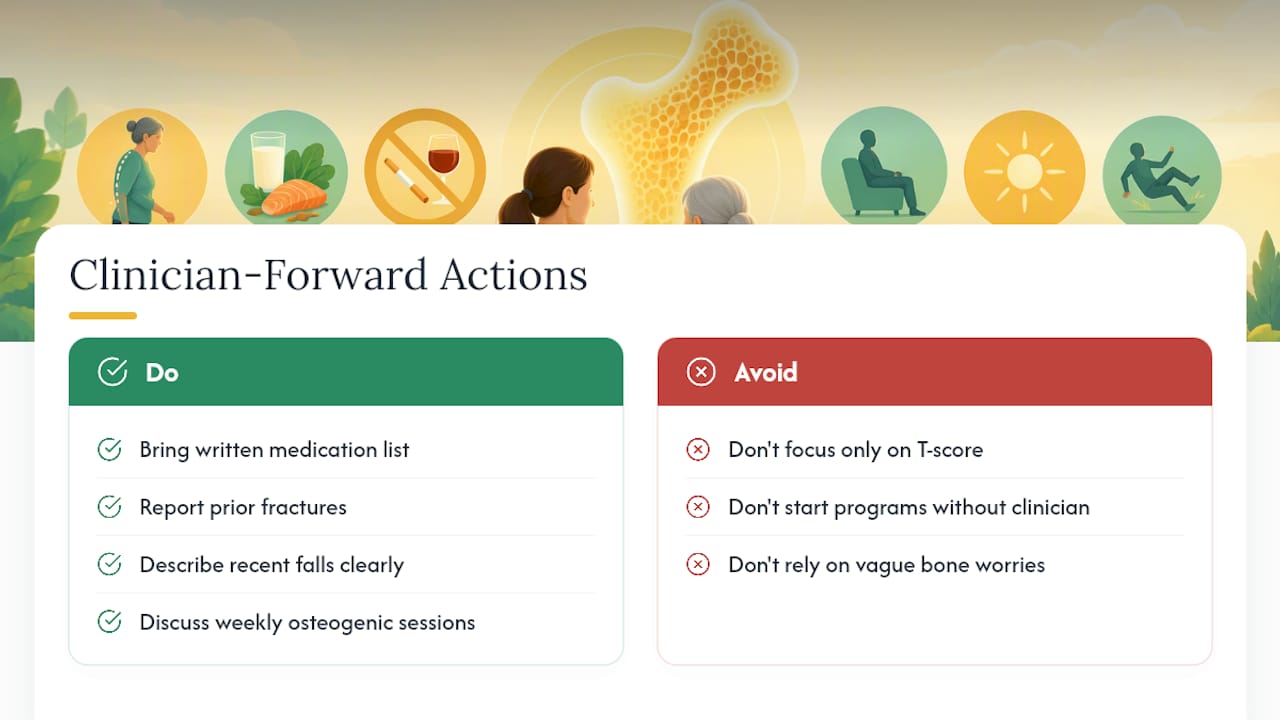
Most people fixate on their T-score and ignore the two questions that actually predict what happens next: have you fractured before, and what is on your medication list? Those two data points often carry more weight than the scan itself. I’d rather see someone walk into an appointment with a written-out medication history and a clear account of any falls than with a decade of vague worry about their bones.
Measurable, weekly interventions matter here. Supervised osteogenic-loading sessions are one option worth discussing with your doctor, alongside standard prevention. Talk to a clinician before starting any new bone program, especially if you fall into one of the higher-risk categories above.
— Aaron
How Osteostrong Fits Into a Bone-Health Plan
If your risk factors are pointing toward “I should be doing something about this,” a once-a-week commitment beats a workout plan you will not stick with. Osteostrong is built around brief, supervised osteogenic loading sessions, one short weekly visit designed to place targeted mechanical load on bone, alongside adjunct options like red light therapy, PEMF mats, and vibration plates available at some wellness centers.
This approach tends to suit people who want a structured, low-time-commitment addition to their bone-health routine rather than another gym membership to feel guilty about skipping. It is not a replacement for medical care. If you have a diagnosed secondary condition or take a high-risk medication, loop in your clinician before starting. Ready to see what a session actually involves? Schedule a visit at your nearest Osteostrong center and ask about what a first session looks like for someone with your risk profile.
This article is general information, not a substitute for advice from a qualified doctor. Consult a qualified healthcare professional about your own circumstances before acting on anything here.
Sources
- Osteoporosis Causes, Risk Factors, & Symptoms | NIAMS
- Osteoporosis — Merck Manual Professional
- USPSTF screening recommendation (2025)
- FRAX and fracture risk estimation | PMC article
FAQ
What Are the Main Risk Factors for Osteoporosis?
The top risk factors are older age, female sex (especially post menopause), small body frame, family history of hip fracture, low calcium or vitamin D intake, low physical activity, smoking, heavy alcohol use, and certain medical conditions or long-term medications. NIAMS lists these as the primary contributors clinicians screen for.
What Are the Three Main Causes of Osteoporosis?
Bone loss generally comes down to three mechanisms: never reaching adequate peak bone mass, breaking down bone tissue too quickly, or failing to rebuild new bone fast enough. Merck Manual attributes these imbalances to aging, hormone deficiency, and vitamin D or parathyroid abnormalities.
Is Osteoporosis Hereditary?
Family history, particularly a parent’s hip fracture, raises your risk, but it is not deterministic. Genetics influence peak bone mass, yet hormones, diet, activity level, and medications all shape whether that inherited risk turns into an actual diagnosis.
How Do Doctors Assess Osteoporosis Risk?
Clinicians use a DXA scan to measure bone density and generate a T-score or Z-score, then often run the FRAX calculator to estimate your 10-year fracture probability. The USPSTF recommends DXA screening for all women 65 and older, and risk-based screening for younger postmenopausal women.
Can Osteogenic Loading Help With Bone Density?
Osteogenic loading is a supervised technique that applies targeted mechanical force to stimulate bone-building response, offered through brief weekly sessions at Osteostrong centers. It is worth discussing as an addition to your plan, not a replacement for medical evaluation or prescribed treatment.
Trackbacks/Pingbacks