

A T-score between -1.0 and -2.5 means osteopenia; -2.5 or lower means osteoporosis. Both raise your fracture risk, but neither label alone decides treatment. What matters more is your overall fracture risk, calculated with tools like FRAX. If you have risk factors or haven’t been scanned, ask your clinician about a DEXA scan now rather than waiting for symptoms that may never come.
TL;DR:
- A DEXA scan’s T-score between -1.0 and -2.5 indicates osteopenia, which often carries a fracture risk similar to osteoporosis, especially with additional factors.
- Calculating fracture risk with tools like FRAX is more important for treatment decisions than the T-score alone, especially when risk factors are present.
- Resistance training, adequate calcium and vitamin D intake, and lifestyle changes are foundational treatments for both osteopenia and osteoporosis, with medication reserved for higher-risk cases.
- Retesting intervals generally range from two to five years, depending on initial scores and treatment status, with small scan variations often reflecting measurement variance.
- Early intervention during osteopenia offers the best chance to improve bone density through consistent, multi-modal strategies, including supervised osteogenic loading if appropriate.
Table of Contents
- Osteopenia vs Osteoporosis: The Difference Comes Down to a Number
- How Doctors Diagnose It: DEXA Scans and the FRAX Calculator
- Who Gets Screened, and Who’s Actually at Risk?
- Why You Might Not Feel Anything Until It’s Serious
- What Actually Works: Treatment Options for Both Conditions
- How Often You Need Retesting, and What to Do Next
- Why the Bone-Health Conversation Needs to Start Earlier
- A Supervised Way to Add Mechanical Loading to Your Plan
- Sources
Osteopenia vs Osteoporosis: The Difference Comes Down to a Number
The distinction between osteopenia and osteoporosis is entirely about degree, not kind. Both describe bone that’s lost density compared to peak bone mass, and both use the same measuring stick: the T-score, generated from a bone density scan.
Osteopenia sits in the middle zone: weaker than normal, but not weak enough to be classified as osteoporosis. Osteoporosis means bones have become porous enough that everyday stress, a fall from standing height, even a hard sneeze, can cause a fracture.
Here’s how the T-score thresholds break down:
- Normal bone density: T-score above -1.0
- Osteopenia: T-score between -1.0 and -2.5
- Osteoporosis: T-score of -2.5 or lower
A T-score compares your bone density to a healthy 30-year-old of the same sex, the age when bone mass typically peaks. A related number, the Z-score, compares you to people your own age and sex instead. Doctors lean on the Z-score more in younger patients or when something other than normal aging (like a hormone disorder) might explain low bone density. For most postmenopausal women and older men, the T-score is what drives the diagnosis, and treating that number as a continuum rather than a hard label is what smart bone care actually looks like.
How Doctors Diagnose It: DEXA Scans and the FRAX Calculator
A DEXA scan, short for dual-energy X-ray absorptiometry, is the diagnostic standard for measuring bone density. It’s quick, low-radiation, and painless. A machine passes two X-ray beams at different energy levels through your spine and hip, the two sites most predictive of fracture risk, and calculates how much mineral is packed into the bone.
Your report will typically include:
- T-score: your primary diagnostic number, compared against peak bone mass
- Z-score: age-matched comparison, useful for younger patients or suspected secondary causes
- Site-specific readings: spine and hip scores can differ, and clinicians often use the lower of the two
- Vertebral fracture assessment: an optional add-on that checks for silent spinal compression fractures
The T-score alone doesn’t tell your doctor whether to start medication. That’s where FRAX comes in: an algorithm combining your bone density with age, weight, prior fractures, family history, and smoking status to estimate your 10-year fracture probability. Common clinical thresholds for starting pharmacologic treatment include a T-score at or below -2.5, a prior fragility fracture, or osteopenia paired with a FRAX-calculated hip fracture risk of 3% or higher, or a major osteoporotic fracture risk of 20% or higher.
Who Gets Screened, and Who’s Actually at Risk?
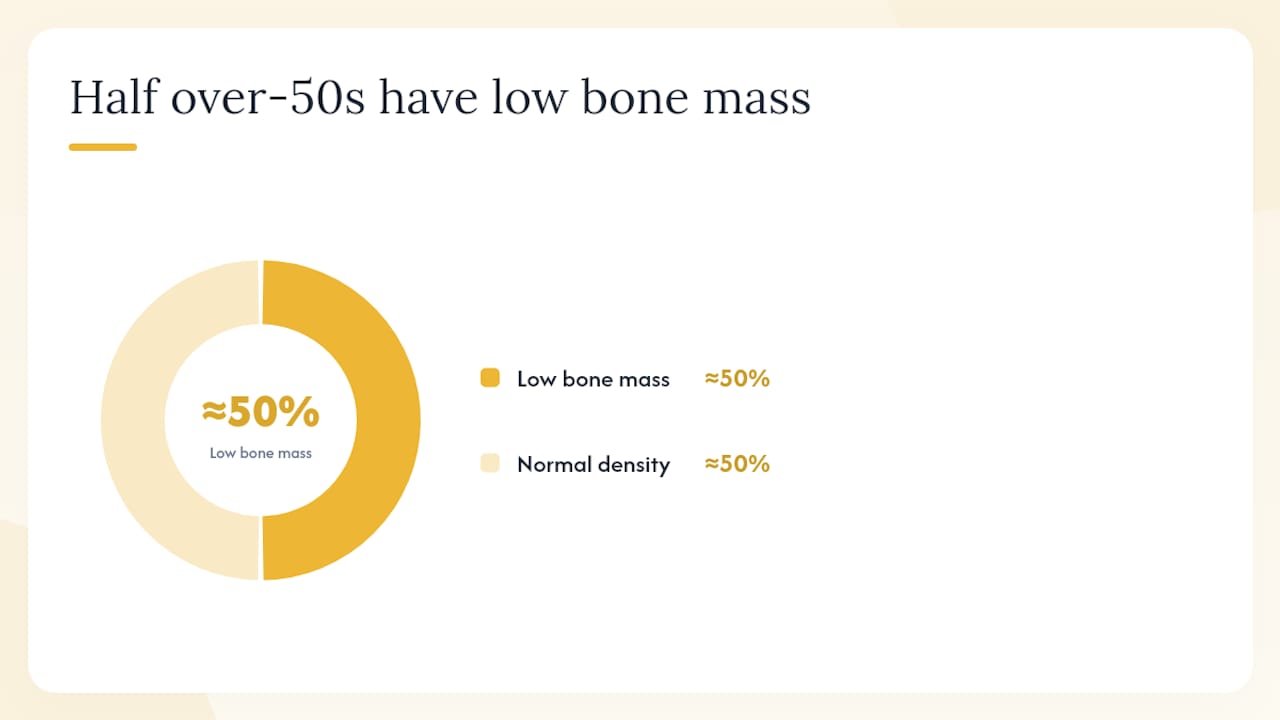
Low bone mass is common enough that finding out you have osteopenia shouldn’t come as a shock. About half of Americans over 50 have some degree of low bone density, which makes it one of the most underdiagnosed conditions in adult medicine, mostly because it produces no symptoms until something breaks.
Risk climbs sharply with a few specific factors:
- Age and sex: women lose bone density fastest in the five to seven years after menopause, when estrogen drops
- Body size: people with lower body weight and smaller frames have less bone mass to begin with
- Medications: long-term glucocorticoid use (prednisone and similar drugs) accelerates bone loss significantly
- Lifestyle: smoking, heavy alcohol use, and sedentary habits all contribute
- Medical history: certain thyroid, digestive, and autoimmune conditions interfere with calcium absorption
Standard screening guidance points to a first DEXA scan at age 65 for women, with earlier testing recommended for anyone carrying multiple risk factors. Guidance for men and for people with secondary risk factors is less standardized, so it’s worth raising the topic yourself instead of waiting to be asked.
Why You Might Not Feel Anything Until It’s Serious
Neither osteopenia nor osteoporosis announces itself. There’s no ache, no stiffness, no early warning sign that tells you your spine is thinning. Osteoporosis is frequently silent until a fracture happens, which is exactly why it’s earned the nickname “the silent disease.”
When fractures do occur, they concentrate in three places:
- Hip: the most severe, often requiring surgery and extended rehabilitation
- Spine: vertebral compression fractures can happen without a fall at all, sometimes from bending or lifting
- Wrist: commonly the first fracture people notice, often from catching a fall
Repeated vertebral fractures cause measurable height loss and the forward-curving spine known as kyphosis. Here’s the part that surprises people: because osteopenia is so much more common than osteoporosis, a large share of all fragility fractures happen in people who were only ever diagnosed with osteopenia. That’s precisely why FRAX matters more than the label. A T-score of -2.0 with three risk factors can carry more real-world danger than a -2.6 with none.
What Actually Works: Treatment Options for Both Conditions
Nonpharmacologic treatment is the foundation for osteopenia and remains essential even after medication starts for osteoporosis.
- Progressive resistance training. Weight-bearing cardio like brisk walking helps, but targeted resistance training against increasing load is more effective at stimulating new bone formation. Bone responds to mechanical stress the same way muscle does: load it progressively, and it adapts.
- Calcium and vitamin D. Most adults need 1,000 to 1,200 mg of calcium daily and 800 to 1,000 IU of vitamin D, ideally from food first. Adequate protein intake also supports the collagen matrix that bone mineral attaches to.
- Mechanical stimulation as an adjunct. Calcium and vitamin D build the raw materials, but they don’t tell bone to remodel. That signal comes from mechanical load, which is why some clinicians recommend pairing resistance work with additional loading modalities to reinforce the stimulus.
- Medication, when the numbers justify it. Pharmacologic therapy is generally recommended for a prior fragility fracture, a T-score at or below -2.5, or osteopenia with elevated FRAX risk. Common drug classes include bisphosphonates (which slow bone breakdown), denosumab (an injectable that targets the same process through a different pathway), and anabolic agents like teriparatide (which actively stimulate new bone formation). Each carries its own risk profile, and the right choice depends on your fracture history, kidney function, and how urgently bone needs to be rebuilt, so this decision belongs in a conversation with your clinician, not a supplement aisle.
Pro Tip: Don’t confuse “weight-bearing” with “strength-building.” A daily walk protects your heart and keeps joints mobile, but it puts far less mechanical load on your hip and spine than a properly loaded squat or leg press. If bone density is the specific goal, resistance intensity matters more than step count.
How Often You Need Retesting, and What to Do Next
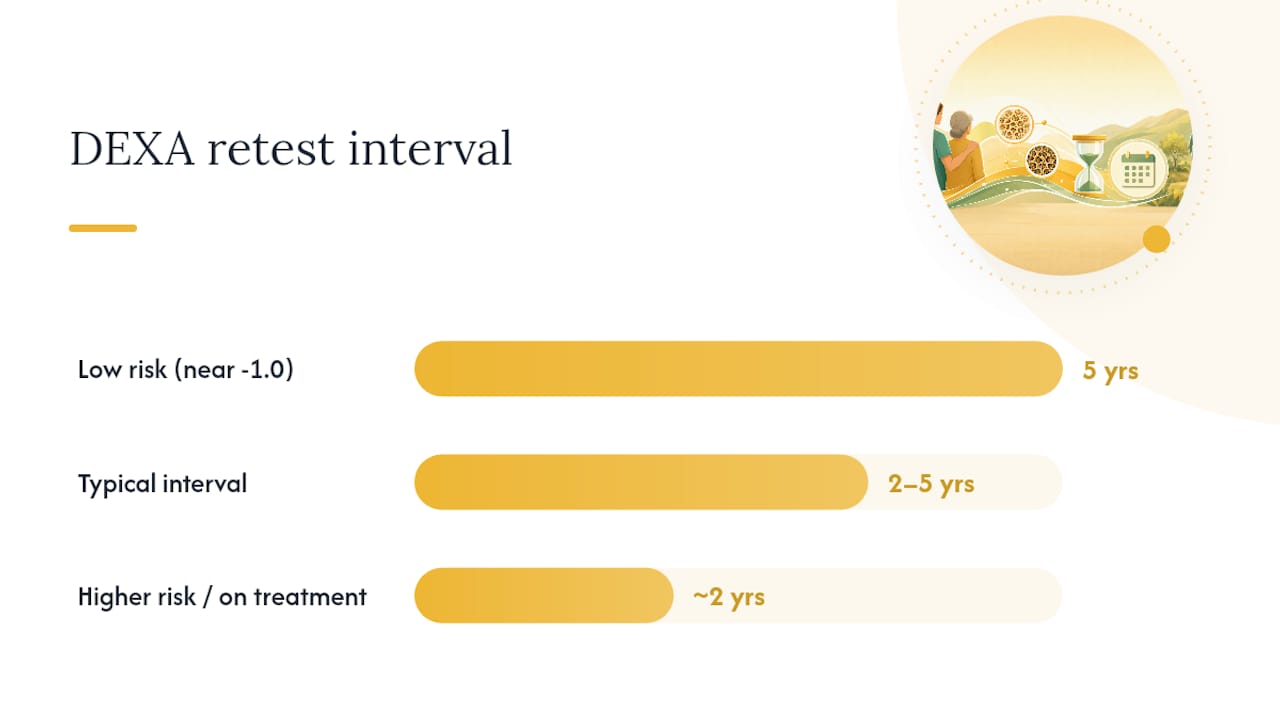
Follow-up DEXA scans are typically spaced two to five years apart, depending on your baseline T-score, risk factors, and whether you’ve started treatment. Someone with a T-score near -1.0 and no risk factors might wait the full five years; someone closer to the osteoporosis threshold, or already on medication, usually gets rescanned sooner.
Small shifts between scans, say, a change from -2.1 to -2.3, often reflect normal measurement variance rather than actual bone loss, so clinicians look at the trend across multiple scans instead of reacting to one number.
A practical next-step checklist:
- Review current medications for bone-density side effects, especially long-term steroids
- Ask for a fall-risk assessment, particularly if you’re over 65
- Start or resume progressive resistance training this week, not “eventually”
- Confirm calcium, vitamin D, and protein intake actually meet daily targets
- Bring your FRAX score into your next clinician visit and ask directly what it means for you
Why the Bone-Health Conversation Needs to Start Earlier
Most people wait until a diagnosis forces the issue, and that’s backwards. The osteopenia stage is the window where intervention pays off the most, yet it’s the stage most often shrugged off because “it’s not osteoporosis yet.”
I’ve spent time around OsteoStrong’s approach to bone health, where clients come in once a week for sessions built around osteogenic loading, brief, high-intensity mechanical loading designed to trigger the same bone-building signal that heavy resistance training produces. It’s positioned as a complement to strength training and nutrition, not a replacement for either, and that framing matters. The clients who do best treat it as one piece of a broader plan that includes clinician oversight, adequate calcium and vitamin D, and consistent resistance work elsewhere in the week.
What I’d push back on is the idea that any single intervention, ours included, is a shortcut around the fundamentals. Bone remodeling takes months to show up on a scan, and the people who see real T-score improvement are the ones stacking multiple consistent inputs, not searching for the one thing that does it all.
— Aaron
A Supervised Way to Add Mechanical Loading to Your Plan
If your DEXA results came back in osteopenia or osteoporosis range, the exercise conversation gets more complicated fast. How much load is safe? What if you have a prior fracture? This is where Osteostrong fits differently than a general gym membership: sessions are once weekly, supervised, and built around brief, high-intensity osteogenic loading rather than open-ended reps you have to gauge on your own.
Osteostrong pairs that loading with supportive recovery therapies, including red light therapy, PEMF mats, and vibration plates, available at centers like the one in Rancho Cordova. None of this replaces your clinician’s guidance, especially if you have osteoporosis or a fracture history; get medical clearance first and bring your FRAX results to that conversation. If you’re cleared to start, book an introductory session and see how the loading protocol fits alongside the resistance training and nutrition plan you’re already building.
This article is general information, not a substitute for advice from a qualified doctor. Consult a qualified healthcare professional about your own circumstances before acting on anything here.
Sources
- PMC article: Clinical standards for bone mineral density (PMC10721754)
- Harvard Health: Osteopenia—When you have weak bones, but not osteoporosis
- Clinical manual: Osteoporosis and low bone mass (NCBI Bookshelf, NBK499878)
- NIAMS: Osteoporosis topic page