
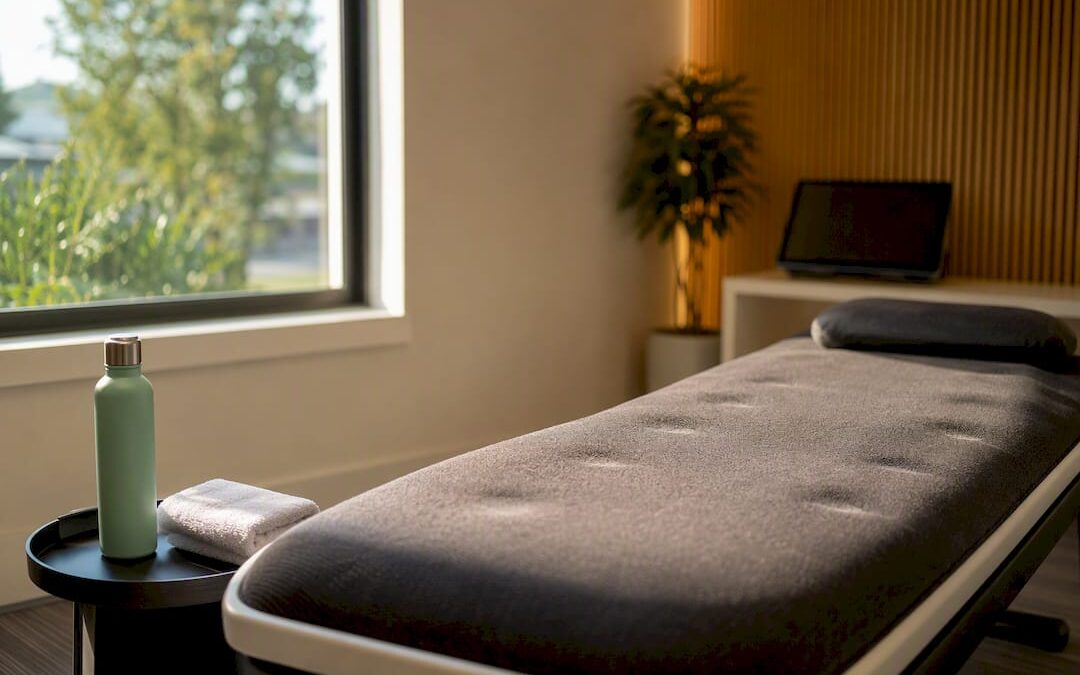
Vibroacoustic therapy benefits show up most reliably in three places: lower acute stress, higher heart rate variability, and short-term boosts to subjective well-being. Randomized controlled trials measuring biosignals like EEG and ECG back this up, and at least one cancer-patient trial found statistically significant gains in vitality and inner balance compared to a control group. Pain relief and sleep improvements show up too, but that evidence is thinner and far less consistent.
Here’s the honest framing: vibroacoustic therapy (VAT) is not a cure for anything. It’s a non-invasive adjunct, meaning it works best stacked alongside other care, not instead of it.
- Acute stress reduction with measurable drops in cortisol
- Increased parasympathetic activity (higher HRV)
- Short-term gains in subjective well-being and relaxation
- Preliminary support for pain and sleep, with real caveats
The evidence snapshot: In a randomized trial of cancer patients, a vibroacoustic sound-bed session produced significant improvements in vitality and inner balance compared to a non-music control condition.
Key Takeaways
Vibroacoustic therapy delivers its most reliable benefits for acute stress reduction and short-term well-being, supported by randomized trials and biosignal data, while pain and sleep outcomes remain promising but preliminary.
| Point | Details |
|---|---|
| Strongest evidence area | Acute stress and relaxation show consistent improvements in HRV and cortisol across multiple studies. |
| Personalization boosts results | Syncing vibration tempo to individual heart rate outperforms fixed-frequency protocols in stress reduction. |
| Pain evidence stays preliminary | Interim recommendations favor 40 Hz sessions of at least 20 minutes until standardized reporting improves. |
| Use it as an adjunct | VAT works best alongside other low-impact therapies, not as a standalone treatment. |
| Screen for contraindications | Implanted cardiac devices, pregnancy, seizure history, and cardiovascular instability warrant clinician clearance first. |
Table of Contents
- What Are the Real Vibroacoustic Therapy Benefits, According to Research?
- How Does Vibroacoustic Therapy Work in the Body?
- What Conditions Does Vibroacoustic Therapy Help With?
- Who Should Avoid Vibroacoustic Therapy?
- What Happens During a Typical Vibroacoustic Session?
- Can You Try Vibroacoustic Therapy at Home?
- What Should Change About How Vibroacoustic Therapy Is Studied and Delivered?
- Vibroacoustic Therapy: Try It as a Complement, Not a Cure
- Sources
What Are the Real Vibroacoustic Therapy Benefits, According to Research?
The strongest data on vibroacoustic healing effects comes from studies that measure something objective, not just how people say they feel. That distinction matters here because self-report can be swayed by expectation, while an EEG trace or a cortisol sample can’t be talked into a good mood.
Start with the biosignal studies. Research combining EEG and ECG monitoring during vibroacoustic sound massage found increased parasympathetic activity, meaning higher heart rate variability, alongside EEG patterns associated with relaxation, according to a study on vibroacoustic stimulation and cognitive stress. Interestingly, participants who started with lower baseline stress showed the strongest physiological response. That’s a detail most marketing pages skip, and it matters if you’re trying to set realistic expectations: VAT doesn’t overpower a severely dysregulated nervous system in a single session. It nudges a moderately stressed one toward calm.
The cancer-patient trial mentioned above is one of the better-controlled studies in the field. Patients undergoing treatment were randomized to a vibroacoustic music intervention or a non-music control, and the vibroacoustic group posted significant gains across multiple well-being subscales, not just one. Vigilance improved too, a smaller but meaningful effect in a population dealing with treatment fatigue, a smaller effect than vitality or inner balance but still meaningful in a population dealing with treatment fatigue.
A separate experimental line of research looked at something more specific: what happens when you sync vibration tempo to a person’s actual heart rate instead of using a fixed frequency. That study found combined vibration-plus-music sessions significantly reduced both subjective stress ratings and salivary cortisol compared to controls, and personalizing the tempo to heart rate improved the effect further, according to research on combined vibration and music interventions. This is a meaningful finding for anyone comparing devices or protocols: a generic 40 Hz hum synced to nothing in particular is not the same intervention as one tuned to your physiology.
Where does the evidence get shakier? Pain. A scoping review of vibroacoustic therapy and pain outcomes concluded the research is heterogeneous. Plenty of individual studies report positive effects, but most fail to report basic parameters like frequency, amplitude, or session length consistently enough to compare results across trials, per the scoping review on VAT and pain. The reviewers landed on an interim recommendation of 40 Hz and sessions of at least 20 minutes, not because that combination is proven optimal, but because it’s the most defensible starting point given what’s published so far.
Here’s a quick rundown of where the evidence stands by outcome:
- Acute stress and relaxation: Strongest evidence, multiple RCTs and biosignal studies agree.
- Subjective well-being (short-term): Strong evidence from randomized trials, including in clinical populations.
- Heart rate variability increases: Well-documented across biosignal studies.
- Pain reduction: Mixed and preliminary; parameter reporting is inconsistent across studies.
- Long-term outcomes of any kind: Largely unstudied; most trials measure single sessions or short courses.
That last point is worth sitting with. Almost none of the available research tracks people for months. If someone tells you VAT permanently rewires your stress response, they’re speaking beyond what any published trial has actually shown.
How Does Vibroacoustic Therapy Work in the Body?
Vibroacoustic therapy works through what researchers call bimodal stimulation: sound you hear and vibration you feel, delivered at the same time, usually through a padded surface like a bed, mat, or chair embedded with transducers. The mechanism isn’t mysterious, but it is layered, and understanding it helps explain why session parameters matter so much.
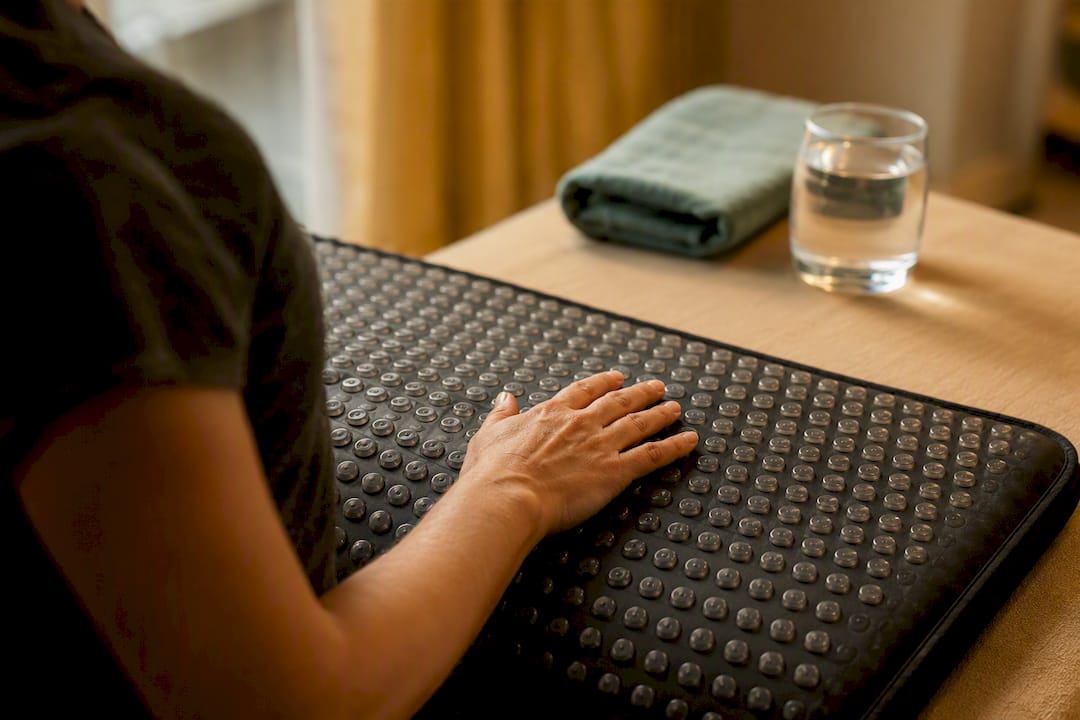
1. Tactile receptor activation. Low-frequency vibration, typically in the 20 to 100 Hz range, stimulates mechanoreceptors in the skin, including Meissner corpuscles (sensitive to light touch and lower frequencies) and Pacinian corpuscles (tuned to deeper, faster vibration). These receptors feed signals into the somatosensory system, which is part of why a vibroacoustic session feels physically different from just listening to calming music through headphones.
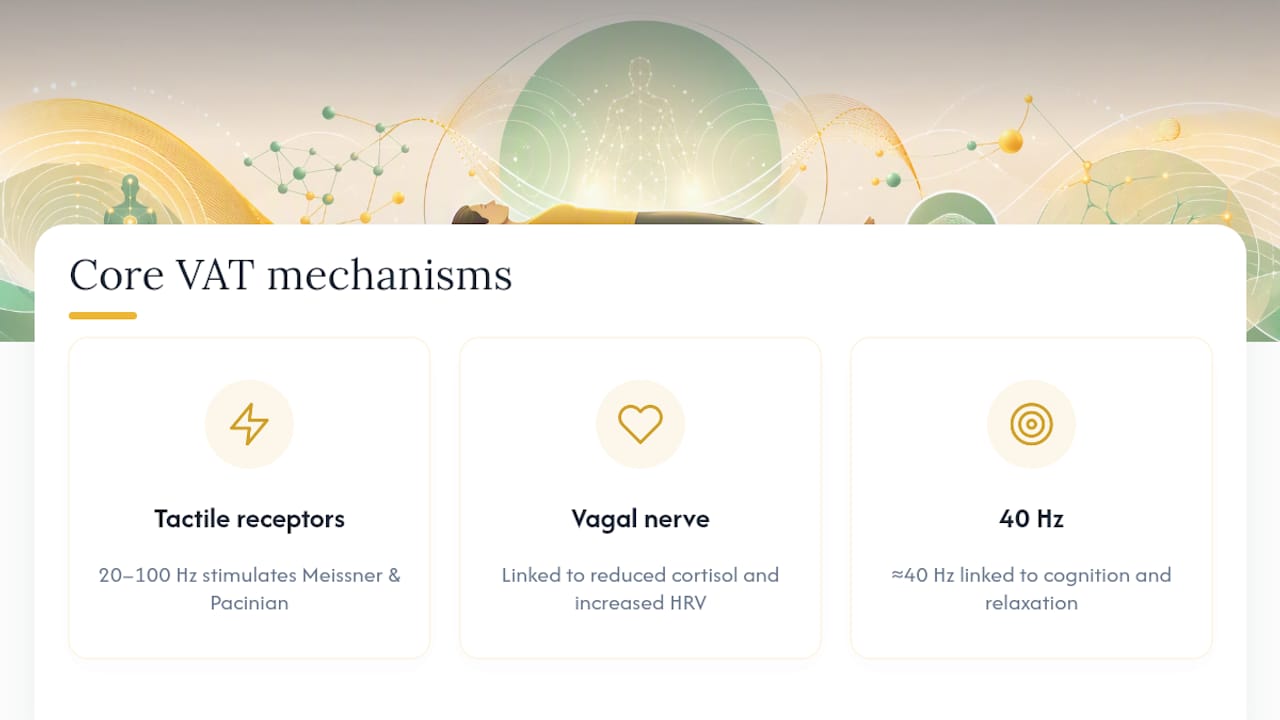
2. Vagal nerve modulation. Multiple studies point to vagus nerve activation as a plausible pathway linking vibration exposure to measurable drops in cortisol, according to research on the mechanisms of sound vibration. The vagus nerve is the body’s primary parasympathetic highway, so nudging it toward activation helps explain the consistent HRV increases seen across trials.
3. Brainwave entrainment near 40 Hz. A specific frequency, roughly 40 Hz, shows up again and again in the literature as a promising target for cognitive and relaxation outcomes. Researchers haven’t fully nailed down why 40 Hz specifically outperforms nearby frequencies, but it’s frequently recommended as an interim standard until better dose-response data exists.
None of this works as advertised if the parameters aren’t tracked. A device that claims “vibroacoustic frequencies” without specifying Hz, amplitude, pulsation pattern, or loudness in decibels is giving you a marketing term, not a protocol. The pain-focused scoping review flagged this exact gap: studies that fail to report those four variables can’t be compared or replicated, which is a real bottleneck for the field’s progress.
Pro Tip: Ask any provider what frequency, amplitude, and session length their device uses. If they can’t answer in specific numbers, they’re likely running the device on a generic preset rather than a protocol grounded in the research.
Vibroacoustic therapy is also distinct from whole-body vibration platforms used for strength or bone training. VAT is built around low-frequency sound embedded in music for nervous-system effects, not mechanical loading for musculoskeletal adaptation, a distinction drawn out in an early conceptual review of low-frequency sound therapy. Conflating the two leads to mismatched expectations about what either modality can actually deliver.
What Conditions Does Vibroacoustic Therapy Help With?
The benefits of vibroacoustic therapy split into a few clear tiers of evidence quality, and knowing which tier a condition falls into keeps you from over- or under-estimating what a session will do.
Stress and anxiety
This is where VAT has its best data. Randomized trials and biosignal studies consistently show reduced physiological arousal, higher HRV, and lower self-reported stress scores after sessions. The heart-rate-synced tempo study found significant drops in both subjective stress ratings and salivary cortisol (p<0.05), reinforcing that this isn’t purely a placebo-driven relaxation response. Personalization to individual heart rate improved outcomes further, which suggests off-the-shelf, one-size-fits-all frequency settings may leave benefit on the table.
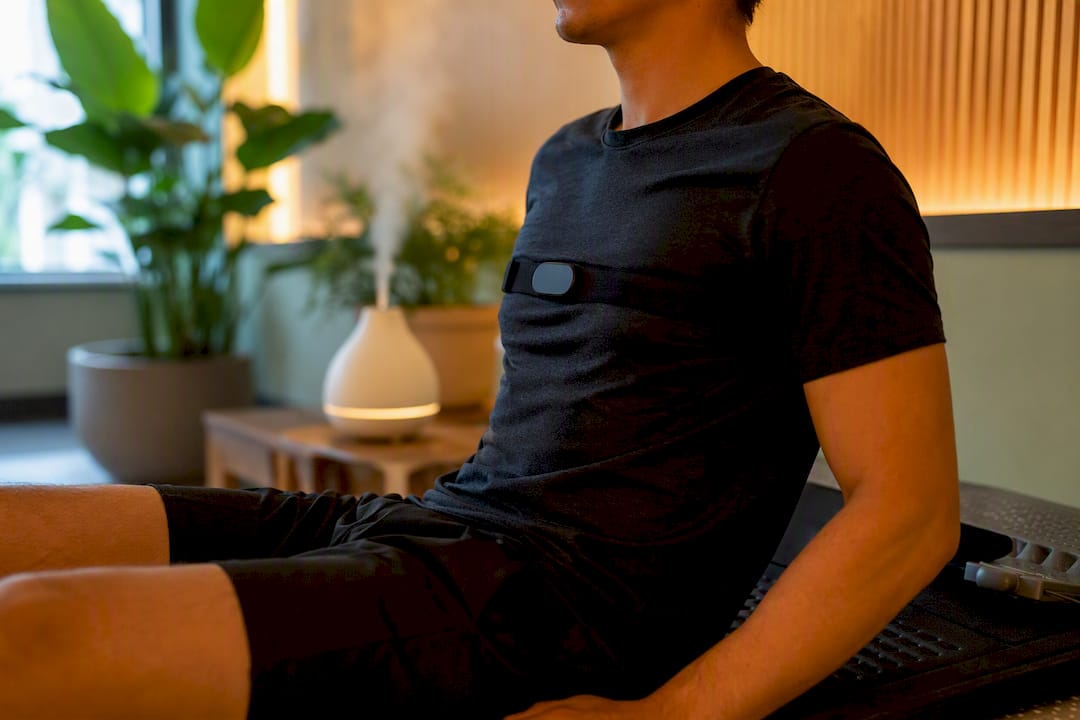
Pain, acute and chronic
Mixed. Many individual studies report meaningful pain reduction, including in postoperative and fibromyalgia-adjacent contexts, but the scoping review’s core conclusion stands: without standardized parameter reporting, it’s hard to say which specific protocol is doing the work. The interim recommendation of 40 Hz for at least 20 minutes per session is a reasonable starting point, not a settled prescription.
Sleep and mood
Short courses of VAT show short-term mood and relaxation improvements in several trials. Nothing in the current literature supports treating VAT as a fix for a diagnosed sleep disorder like insomnia or sleep apnea. Think of it as something that can smooth the on-ramp to sleep on a given night, not a substitute for a sleep medicine evaluation.
Neurorehabilitation and motor recovery
Here VAT shows up mainly as an adjunct. Some studies report improvements in spasticity and motor function when vibroacoustic sessions are layered onto standard rehabilitation, but protocols vary widely from one study to the next, which limits how confidently anyone can generalize the results. If you’re recovering from a neurological event, VAT is a reasonable add-on to discuss with your rehab team, not a replacement for physical therapy.
Circulation and muscle relaxation
This is the oldest claim tied to vibroacoustic technology, dating back to when an early physioacoustic chair received FDA review in 1996 covering three specific claims: improved blood and lymphatic circulation, decreased pain and stress, and increased muscle relaxation and mobility, according to the historical review of physioacoustic device claims. That’s useful context, not a current blanket endorsement. Modern research reframes these same categories with better instrumentation, but the underlying claims trace back decades.
- Best-supported use: Acute stress reduction, short-term relaxation
- Moderately supported: Subjective well-being in clinical populations (cancer care, for example)
- Emerging, needs more data: Pain management, neurorehab adjunct use
- Should not be relied on alone: Diagnosed sleep disorders, chronic disease management
If you’re managing bone health alongside general wellness, this is also where modalities tend to get combined rather than used in isolation. Facilities that already run vibration plate and PEMF programs often add short vibroacoustic sessions as a low-effort complement, not as the primary intervention.
Who Should Avoid Vibroacoustic Therapy?
VAT has a good safety profile in published research, but “generally safe” isn’t the same as “safe for everyone.” A handful of conditions warrant a conversation with a clinician before you book a session.
Cautions that call for medical clearance first:
- Implanted cardiac devices, including pacemakers and defibrillators, since vibration and electromagnetic interactions with device hardware aren’t well studied
- Pregnancy, particularly in the first trimester, given the lack of dedicated safety trials in pregnant populations
- A history of seizures, since some vibroacoustic protocols overlap with frequencies used in photic or sensory entrainment research
- Uncontrolled cardiovascular instability, including recent cardiac events or unmanaged arrhythmia
- Acute deep vein thrombosis or active blood clotting disorders, where vibration near affected areas isn’t advisable
Minor side effects reported anecdotally include temporary dizziness, mild nausea, or a brief headache, usually tied to sessions run at unusually high amplitude or unusually long duration. These tend to resolve quickly once the session ends.
Three steps to take before your first session:
- Disclose your full medical history to the provider, specifically implanted devices, pregnancy status, seizure history, and any recent cardiac events.
- Start with a shorter session than the standard 20 to 30 minutes if you’re new to the modality, and see how your body responds.
- Stop and seek medical advice if you notice worsening dizziness, chest discomfort, or unusual pain during or after a session, rather than pushing through it.
If you’re weighing vibroacoustic sessions against other vibration-based modalities, it’s worth reviewing contraindications for vibration plate therapy as a comparison point, since some caution categories overlap even though the mechanisms differ.
What Happens During a Typical Vibroacoustic Session?
Most vibroacoustic sessions follow a fairly predictable structure, whether you’re lying on a specialized bed, sitting in a chair, or resting on a mat embedded with transducers. Positioning matters more than people expect: full-body contact with the vibrating surface, rather than partial contact, is how most trial protocols deliver the intervention.
Session length in the research generally is at least 20 minutes, consistent with common interim recommendations for pain-related outcomes. Shorter sessions show up in some acute-stress studies, but the more consistent through-line across trials favors that 20-minute floor.
Frequency ranges used across the literature typically span low frequencies between about 20 and 100 Hz, with particular focus on around 40 Hz. Why 40 Hz keeps reappearing isn’t fully settled, but it shows up often enough in relaxation and cognitive-outcome studies that it’s become something of a working standard, even though the field hasn’t run head-to-head comparisons against nearby frequencies to prove it’s uniquely optimal.
How often should you go?
- For acute stress or a single tense week, daily or near-daily short sessions align with the acute-stress trial designs.
- For chronic or supportive use, such as ongoing pain management or general relaxation maintenance, once or twice weekly sessions match the cadence used in longer supportive-care studies.
- There’s no published protocol supporting a “more is always better” approach. Overuse without measurable benefit is a signal to reassess, not push harder.
Before committing to a provider or a package, ask these questions:
- What frequency range does your device use, and can you tell me the specific Hz?
- Is the vibration synchronized to music, and if so, is tempo fixed or personalized to my heart rate?
- What’s the typical session length, and is that based on published research or general convention?
- Do you track any outcome measures, even simple pre/post stress ratings?
A provider who can answer these specifically is working from something closer to the actual evidence base than one offering vague wellness language.
Can You Try Vibroacoustic Therapy at Home?
You can experiment with a rough approximation of vibroacoustic therapy at home, but it’s worth being honest about the ceiling on what that gets you. A smartphone set to vibrate on a table, paired with a synchronized playlist, delivers some tactile and auditory stimulation. It does not replicate the full-body transducer contact, controlled frequency delivery, or amplitude precision used in the actual clinical trials.
If you want to test the waters before committing to professional sessions, a few things to check:
- Verify any device or app-based approach lets you see or set an actual frequency, not just a vague “relaxation mode”
- Track your response with something concrete, like the PSS-10 stress scale or a simple 0 to 10 pain rating (NRS) before and after
- Keep a basic sleep diary for a week if sleep is your primary goal, rather than relying on memory
- Consider a consumer heart rate monitor if you want a rough proxy for HRV changes, understanding it won’t match research-grade ECG equipment
Pro Tip: Log your stress rating immediately before and 15 minutes after each session for two weeks. A pattern of consistent, even modest improvement is more meaningful than any single “great” session, since single-session responses can be swayed by mood, sleep debt, or simple novelty.
At-home experimentation is not appropriate if you fall into any of the caution categories above, particularly implanted cardiac devices or uncontrolled cardiovascular issues. In those cases, skip the DIY route entirely and talk to a clinician about whether supervised sessions make sense first.
What Should Change About How Vibroacoustic Therapy Is Studied and Delivered?
Osteostrong’s clinical experience running vibration-based modalities alongside osteogenic loading points to one consistent pattern: patient compliance stays high when a therapy like this is framed as a short, well-defined adjunct session rather than a standalone treatment plan. That framing matches what the research actually supports.
The field’s biggest weakness isn’t whether vibroacoustic therapy works. It’s that too few studies report the four numbers that would let anyone replicate a result: frequency, amplitude, pulsation, and loudness. Fix that reporting gap, and the next decade of research gets a lot more useful.
Three priorities would move this field forward faster:
- Standardize parameter reporting in every published trial, following the four-variable recommendation from the pain-focused scoping review.
- Run more RCTs with biosignal endpoints like HRV and EEG rather than relying solely on self-report, since biosignals are harder to bias with expectation.
- Test personalization protocols, such as heart-rate-synced tempo, against fixed-frequency approaches head-to-head.
Pro Tip: If a clinic offers vibroacoustic sessions as one piece of a broader low-impact wellness stack, ask how they measure whether it’s actually helping you specifically, not just whether clients generally report liking it.
Vibroacoustic Therapy: Try It as a Complement, Not a Cure
Vibroacoustic therapy deserves a place in a broader wellness routine, but not the starring role some marketing suggests. The research is genuinely encouraging on acute stress and short-term well-being, genuinely thin on long-term pain and sleep outcomes, and completely silent on anything beyond a few weeks of use. That’s not a knock against the modality. It’s just where the evidence currently sits.
What gets overlooked most often is the personalization piece. Studies syncing vibration tempo to individual heart rate consistently beat fixed-frequency setups, yet most commercial devices still run generic presets. If you’re paying for sessions, that’s the detail worth asking about before anything else.
The other overlooked point: VAT works best stacked with other low-impact modalities rather than used in isolation. If you’re already managing bone density or general mobility through structured programs, adding a short vibroacoustic session alongside PEMF therapy or similar low-impact tools is a more evidence-aligned approach than treating it as a standalone fix.
Skip anyone promising vibroacoustic therapy will cure chronic pain or replace medical sleep treatment. Trust the modality for what the trials actually show: a legitimate, low-risk tool for calming an overactive stress response, with real but still-developing potential elsewhere.
— Aaron
Sources
- Feeling the sound – short-term effect of a vibroacoustic music intervention on well-being and subjectively assessed warmth distribution in cancer patients—A randomized controlled trial
- Effects of Vibroacoustic Stimulation on Psychological, Physiological, and Cognitive Stress – PMC
- Exploring combined vibration and music interventions for acute stress reduction: insights from two experimental studies
Trackbacks/Pingbacks