
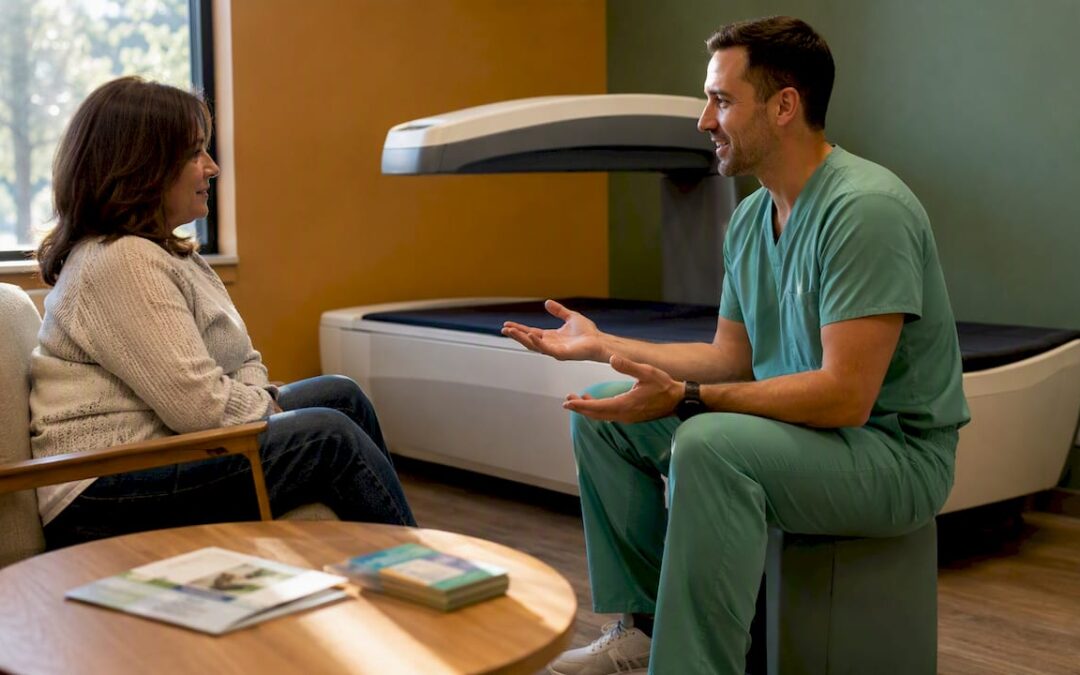
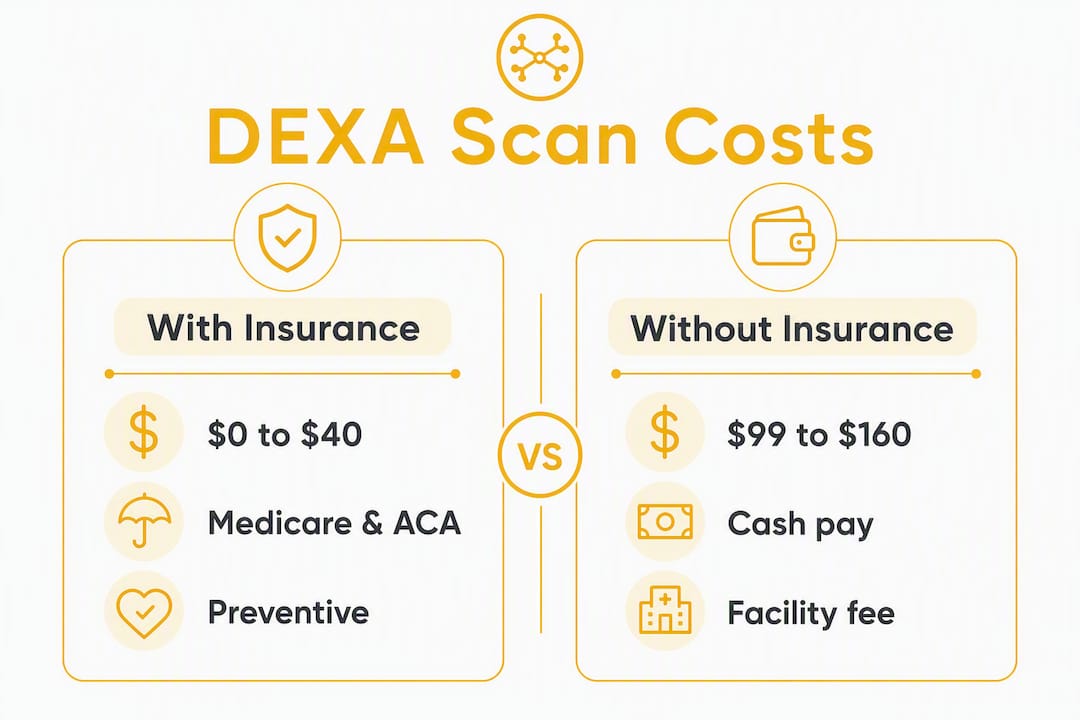
A standard bone-density DEXA scan runs roughly $99–$160 as a cash/self-pay price at most U.S. imaging centers, with a national median around $140. If you have Medicare or private insurance and your doctor ordered the scan for osteoporosis screening, there’s a good chance you pay nothing out of pocket.
Here’s the quick version:
- Medicare Part B covers a bone-density DEXA every 24 months for qualifying beneficiaries, typically at $0 cost-sharing when the provider accepts Medicare assignment.
- Private insurance often covers clinical bone-density screening at $0 under ACA preventive-care rules for eligible patients, though diagnostic scans may hit your deductible.
- Wellness body-composition scans (the kind fitness studios offer) are almost always self-pay, running $40–$200 depending on the facility.
- Hospital-based DEXA can reach $150–$400 before insurance, while freestanding imaging centers are usually cheaper and more transparent on price.
The biggest variable isn’t your zip code. It’s whether your scan is coded as preventive screening or something else, and whether you’re at a hospital or an independent clinic.
Table of Contents
- How much does a DEXA scan cost? National price snapshot
- Does insurance cover a DEXA scan?
- How does facility type affect the price you pay?
- What drives price differences between providers?
- Practical steps to lower your out-of-pocket cost
- What happens during a DEXA scan and how are results reported?
- Common billing surprises and hidden fees to watch for
- How prices vary by state
- How these prices were estimated
- Key Takeaways
- The part most pricing guides miss
- Osteostrong: a practical next step after your DEXA
- Authoritative sources to verify rates and coverage
How much does a DEXA scan cost? National price snapshot
Cash prices for a standard axial DEXA (hip and spine, CPT code 77080) cluster around $140 nationally, with most self-pay patients landing between $99 and $160. The full range is wider, from about $55 on the low end to $550 at high-cost facilities, but those extremes reflect outlier billing rather than typical experience.
| Scan type | Typical cash range | Notes |
|---|---|---|
| Clinical bone-density DEXA (axial, CPT 77080) | $99–$160 | Freestanding imaging centers; national median ~$140 |
| Hospital-based bone-density DEXA | $150–$400 | Facility fee adds cost; professional fee may be separate |
| Wellness body-composition DEXA | $40–$200 | Fitness/wellness studios; rarely insurance-covered |
| Membership/mobile provider | $40–$75 per scan | Lower per-scan cost on membership plans |
One number worth keeping in mind: Medicare’s 2026 reimbursement for CPT 77080 is approximately $39.41, while the average provider charge runs around $218.61. That’s roughly a 5.5x markup between what Medicare pays and what a facility lists. For patients on high-deductible plans, that gap is exactly why asking for the all-in cash price before scheduling often saves money.
Peripheral DEXA scans (wrist or heel, CPT 77081) tend to run lower than axial scans, though they’re less commonly ordered for full osteoporosis diagnosis. Full-body composition scans at wellness studios sit at the lower end of the $40–$200 range when purchased as standalone sessions, and membership plans at mobile providers can bring per-scan prices down to $40–$75.
Does insurance cover a DEXA scan?
The short answer: yes, for the right patient with the right indication, and often at $0. The longer answer involves how the scan is coded and which plan you have.
Medicare Part B
Medicare covers a bone-density DEXA every 24 months for qualifying beneficiaries, including women at estrogen deficiency risk, individuals with vertebral abnormalities, patients on long-term glucocorticoid therapy, and those with primary hyperparathyroidism. When the provider accepts Medicare assignment, the patient’s share is typically $0 after the Part B deductible is met, and many providers waive cost-sharing entirely for covered preventive services.
Medicare’s national average patient payment for CPT 77080 is $29, with the total average cost to Medicare around $68. That $29 figure reflects cost-sharing for patients who haven’t met their deductible; once the deductible is satisfied, the out-of-pocket amount drops further.
Private insurance and ACA preventive-care rules
Screening bone-density tests carry a USPSTF Grade B recommendation for women 65 and older and for younger postmenopausal women at elevated fracture risk. Under ACA rules, Grade B preventive services must be covered at $0 cost-sharing by most non-grandfathered plans when the scan is coded as preventive screening. The catch: if your doctor orders the scan as diagnostic rather than screening, it may be subject to your deductible and coinsurance instead.
Pro Tip: Before scheduling, ask your doctor’s office how the scan will be coded. “Screening” and “diagnostic” can mean the difference between $0 and several hundred dollars on a high-deductible plan.
HSA and FSA use
Body-composition DEXA scans for fitness or wellness are rarely covered by traditional health insurance, but they do qualify as a medical expense under IRS rules for HSA and FSA accounts. If you’re paying out of pocket for a wellness scan, using pre-tax HSA or FSA dollars effectively discounts the price by your marginal tax rate. Keep the itemized receipt, since the scan must be for a medical purpose (body composition assessment) rather than purely cosmetic.
CPT codes and why they matter
The billing code determines coverage. CPT 77080 is the standard axial bone-density scan (hip and spine). CPT 77081 covers peripheral sites. Wellness body-composition scans are billed under different codes and are almost never covered. If a facility gives you a vague price quote without mentioning a CPT code, ask directly: “What CPT code will you bill for this scan?” A facility that can’t or won’t answer that question is a red flag.
How does facility type affect the price you pay?
Where you get your scan matters as much as whether you have insurance.

Hospital radiology departments carry the highest prices because they layer a facility fee on top of the professional (radiologist) fee. A scan that costs $140 at a freestanding center might run $300–$400 at a hospital outpatient department once both fees are combined. Patients with high-deductible plans often pay the full negotiated rate until their deductible is met, which can mean a significant bill even with insurance.
Freestanding imaging centers and independent clinics are almost consistently more cost-effective than hospital-affiliated departments. They carry lower overhead, and many publish a clear cash price upfront. The technical and professional fees are often bundled into a single quoted price, which makes comparison shopping straightforward.
Wellness and body-composition studios sit at the low end for price, typically $40–$150 for a full-body composition scan. These facilities use the same DXA hardware but focus on fat mass, lean mass, and visceral fat rather than T-scores. Insurance won’t cover these, but the price is low enough that most clients pay out of pocket without much friction.
| Facility type | Typical cash range | Insurance coverage | Professional fee included? |
|---|---|---|---|
| Hospital outpatient radiology | $150–$400 | Often yes (clinical) | Sometimes separate |
| Freestanding imaging center | $99–$160 | Often yes (clinical) | Usually bundled |
| Wellness/body-composition studio | $40–$200 | Rarely | Usually bundled |
| Mobile/membership provider | $40–$75 | Rarely | Usually bundled |
One practical note: even at freestanding centers, the radiologist who reads your scan may bill separately from the facility. Always ask whether the quoted price includes the interpretation fee.
What drives price differences between providers?
Geography is a factor, but it’s not the biggest one. A few variables explain most of the spread.
- Technical vs. professional fee separation. Some facilities bill one all-in price; others send two separate bills (one from the imaging center, one from the radiologist). If you only asked about the facility fee, the radiologist’s bill can feel like a surprise.
- Scan scope and add-ons. A standard hip-and-spine scan costs less than one that adds vertebral fracture assessment (VFA) or a full-body composition overlay. Each add-on typically carries its own CPT code and charge.
- Geographic market. Urban markets in California, New York, and the Northeast tend to run higher than rural or mid-South markets. Local cost-of-living, facility density, and competition all play a role.
- Negotiated insurer rates. If you have insurance, the price you pay depends on your plan’s negotiated rate with that specific facility, not the facility’s list price. A hospital might charge $350 but accept $180 from your insurer.
- Membership and bundled pricing. Some wellness studios and mobile providers offer membership plans that drop the per-scan price significantly, useful if you plan to track body composition quarterly.
Pro Tip: If you’re uninsured or on a high-deductible plan, call the facility’s billing department (not the scheduling line) and ask for the “self-pay” or “cash-pay” price for CPT 77080. That number is almost always lower than the list price.
Practical steps to lower your out-of-pocket cost
Getting a fair price on a DEXA scan is mostly about asking the right questions before you book.
- Call the billing department directly. Ask for the all-in cash price for CPT 77080, including both the technical and professional (radiologist) fee. Get a dollar amount, not a range.
- Compare freestanding centers to hospital departments. Use GoodRx or Medicare’s Procedure Price Lookup to see what facilities near you charge before calling.
- Check whether your insurer covers it as preventive care. Call the member services number on your insurance card and ask: “Is CPT 77080 covered as a preventive service under my plan, and what is my cost-sharing?”
- Use HSA or FSA funds for wellness scans. If you’re paying out of pocket for a body-composition scan, pay with your HSA or FSA card to use pre-tax dollars.
- Ask about mobile or membership options. Mobile DEXA providers and wellness studios with membership plans can bring per-scan costs down to $40–$75.
- Confirm prior authorization requirements. Some private plans require preauthorization for diagnostic DEXA. Skipping this step can result in a denied claim and full out-of-pocket responsibility.
Sample phone script for the billing department:
“Hi, I’m scheduling a bone-density scan and want to confirm the all-in cash price. What CPT code will you bill? Does that price include the radiologist’s interpretation fee, or will that be billed separately? Do I need a prior authorization from my insurer?”
That script takes two minutes and can save you hundreds of dollars.
What happens during a DEXA scan and how are results reported?
A standard hip-and-spine DEXA appointment takes 10–30 minutes from check-in to leaving. You lie fully clothed on a padded table while a low-dose X-ray arm passes over your body. No injection, no claustrophobia, no preparation required beyond removing metal objects.
- The scanner measures bone mineral density at the lumbar spine and one or both hips.
- Radiation exposure is extremely low, roughly equivalent to a few hours of natural background radiation and far below a standard chest X-ray.
- Results are reported as a T-score (comparison to a healthy young adult reference population) and a Z-score (comparison to age- and sex-matched peers).
A T-score at or above -1.0 is considered normal. Between -1.0 and -2.5 indicates osteopenia; -2.5 or below meets the clinical threshold for osteoporosis. The Z-score is more relevant for younger patients and premenopausal women, where secondary causes of bone loss are more likely.
For body-composition scans, the report shows fat mass, lean mass, and visceral adipose tissue estimates. DEXA body-fat measurements carry an accuracy margin of roughly ±1–2%, which makes it one of the more precise non-invasive methods available for tracking changes over time. Bone-density results are typically available within a few days; body-composition reports from wellness studios are often printed on the spot.
Common billing surprises and hidden fees to watch for
The price you’re quoted and the price on your bill can diverge in a few predictable ways.
- Separate radiologist bill. The imaging center and the radiologist who reads your scan are often different billing entities. You may receive two separate bills weeks apart.
- Vertebral fracture assessment (VFA) add-on. Some facilities include VFA as a default add-on without telling you. It’s billed under a separate CPT code and adds to your total.
- Full-body composition overlay. If a clinical facility offers to add a body-composition report to your bone-density scan, that add-on may not be covered by insurance and will be billed separately.
- Facility list price vs. negotiated rate. Hospital price-transparency files show cash-pay prices for the same CPT code ranging from under $20 to over $2,500 at different facilities. The number on a hospital’s price list is rarely what an insured patient actually pays, but it’s what an uninsured patient may be billed before any discount is applied.
- Vague price quotes. If a facility tells you “it depends on your insurance” without giving you a cash price, push back. Every facility is required by federal price-transparency rules to publish a machine-readable price list; ask for the cash-pay price for CPT 77080 specifically.
- Prior authorization denials. If your plan requires preauthorization and you skip it, the claim may be denied entirely, leaving you with the full facility charge.
How prices vary by state
Geographic variation in DEXA pricing is real, though the spread within a state often exceeds the spread between states. Urban markets and high-cost-of-living areas consistently run higher; rural and mid-South markets tend to run lower.
| State/Market | Typical cash range (freestanding) | Notes |
|---|---|---|
| California | $140–$400 | Urban premium; high facility overhead |
| Florida | $140–$160 | Competitive market; many freestanding options |
| Georgia | $99–$160 | Mid-range; lower cost-of-living markets |
| Delaware / DC metro | $140–$218.61 | Northeast premium; hospital-heavy market |
| Texas | $99–$160 | Large market; wide variation by city |
These ranges reflect freestanding imaging centers. Hospital-based pricing in any of these markets can run $150–$400 or more. The best way to verify local pricing is to call two or three freestanding imaging centers in your area and ask for the self-pay price for CPT 77080.
How these prices were estimated
The price ranges in this article draw from several sources: clinic-reported cash prices aggregated by Expected Healthcare (data collection noted June 2026), Medicare’s Procedure Price Lookup tool for national average Medicare reimbursement figures, provider charge data from CareRoute for CPT 77080, and hospital price-transparency file analysis from Itemized Health.
A few limitations to keep in mind:
- “Cash price” was standardized as the self-pay rate before any insurance adjustment, but facilities define this differently. Some include the professional fee; others do not.
- Prices change. The figures here reflect mid-2026 data; reimbursement rates and facility pricing can shift with annual Medicare fee schedule updates.
- State-level ranges are illustrative, not exhaustive. A single facility in a high-cost urban market can skew a state average significantly.
- Separate billing components (technical fee, professional fee, add-ons) are not always reported together, so “all-in” cash prices are harder to verify than facility-only quotes.
Always confirm the current price directly with the facility before scheduling.
Key Takeaways
Most U.S. adults pay $99–$160 cash for a clinical bone-density DEXA, or $0 with Medicare or qualifying private insurance when the scan is medically indicated.
| Point | Details |
|---|---|
| Typical self-pay range | Cash prices for a clinical bone-density DEXA run $99–$160 nationally, with a median around $140. |
| Who usually pays $0 | Medicare beneficiaries and ACA-eligible patients with qualifying private insurance often pay nothing for covered screening. |
| Ask for CPT code and all-in price | Always request the CPT code (77080) and confirm whether the radiologist’s fee is included before booking. |
| Freestanding centers beat hospitals | Independent imaging centers consistently offer lower, more transparent cash prices than hospital outpatient departments. |
| Osteostrong for bone health action | After your DEXA establishes a baseline, Osteostrong’s osteogenic loading sessions give you a weekly, evidence-backed way to work on improving that score. |
The part most pricing guides miss
The conversation around DEXA scan cost tends to stop at the number. What it rarely addresses is what you do with the result.
A T-score of -1.8 tells you something is happening with your bone density. It does not tell you what to do about it. Most people leave the imaging center with a report, a referral to “discuss with your doctor,” and no clear path forward. That gap is where a lot of bone-health outcomes get lost.
At Osteostrong, we see this pattern regularly. Members come in after a DEXA showing osteopenia or early osteoporosis, often having been told to “take calcium and come back in two years.” The scan is useful. The follow-up, historically, has been thin.
What we’d push back on is the assumption that a DEXA result is primarily a diagnostic endpoint. It’s more useful as a baseline. The scan tells you where you are; the question is what you’re doing between now and the next one. For bone density specifically, the evidence points toward mechanical loading as the primary stimulus for bone formation. That’s what osteogenic loading is designed to deliver.
If you’re navigating DEXA pricing because you’re trying to understand your bone health, the scan is the right first step. Just don’t let it be the last one.
Osteostrong: a practical next step after your DEXA
Getting your DEXA result is the starting line, not the finish. If your scan shows osteopenia or osteoporosis, or you simply want to build bone density before a problem develops, Osteostrong offers a weekly, science-backed approach that works alongside clinical care.

Osteostrong’s core service is osteogenic loading: brief, supervised sessions using specialized equipment that applies forces to the skeleton far beyond what conventional exercise can generate, stimulating the bone remodeling process. Members also have access to red light therapy, PEMF mats, BioCharger sessions, compression therapy, vibration plates, and hydromassage lounges, all in a single weekly visit. It’s not a replacement for a medically ordered DEXA when your doctor recommends one, but it’s a direct answer to the question that scan raises: what do I do now?
Locations are available across the U.S., including Rancho Cordova, Lafayette East, and Oklahoma City. To learn more about how osteogenic loading works and whether it fits your situation, visit centers.osteostrong.me to find a center near you.
Osteostrong is a wellness service. It does not replace medically ordered DEXA scans or clinical care for osteoporosis.
Authoritative sources to verify rates and coverage
Prices and coverage rules change. These are the primary sources worth bookmarking:
- Medicare Procedure Price Lookup (CPT 77080) — national average Medicare reimbursement and patient cost-sharing figures, updated with annual fee schedule changes.
- Expected Healthcare DEXA pricing page — clinic-reported cash prices with median and range data.
- CareRoute CPT 77080 cost page — provider charge vs. Medicare reimbursement comparison for CPT 77080.
- Itemized Health DXA pricing — hospital price-transparency file analysis showing the full range of facility cash prices.
- MedlinePlus bone density scan overview — plain-language clinical explanation of what the scan measures and who needs it.
- RadiologyInfo.org DEXA overview — procedure details, radiation dose, and result interpretation from the radiological societies.
This article provides general pricing and coverage information, not medical or financial advice. Confirm current Medicare rules, insurer coverage terms, and local cash prices directly with your provider or a qualified professional before scheduling.