
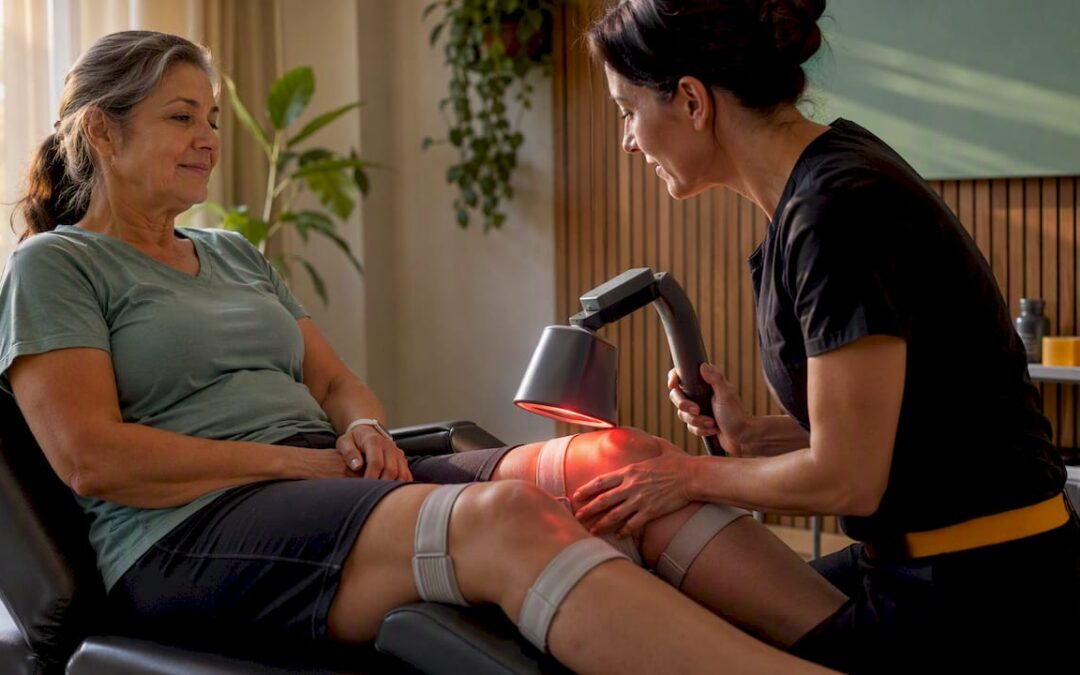
Clinical red light therapy (photobiomodulation, or PBM) is a reasonable, evidence-backed adjunct for many adults with osteoarthritis-related joint pain, and it pairs well with bone-building programs like osteogenic loading at Osteostrong. A 2025 network meta-analysis synthesizing 32 randomized controlled trials and 2,078 patients ranked low-level light therapy (LLLT) highest among physical modalities for knee OA pain and function. Most responders see meaningful improvement after a few weeks of consistent sessions using clinical-grade panels delivering red (630–660nm) and near-infrared (810–850nm) wavelengths. It is not a substitute for prescribed medications or surgery, but for mild-to-moderate knee OA, the evidence is solid enough to act on.
Table of Contents
- How does red light therapy work on joints and bone tissue?
- What does the clinical evidence say about red light therapy for arthritis?
- Safety, side effects, and who should get clearance first
- Why clinical devices outperform home units for joint and bone targets
- What to expect from a clinical protocol
- How red light therapy pairs with osteogenic loading and other clinic services
- How to choose a clinic that actually delivers therapeutic results
- Real-world client examples
- Key Takeaways
- Why Osteostrong integrates red light therapy with bone-building programs
- Ready to try red light therapy with clinical-grade support?
- Useful sources
How does red light therapy work on joints and bone tissue?
Light at red and near-infrared wavelengths is absorbed by cytochrome c oxidase, a mitochondrial enzyme, triggering a cascade that increases ATP production, releases nitric oxide, and dials down inflammatory signaling. Think of it as a cellular battery recharge: more ATP means chondrocytes (cartilage cells) can repair and replicate more efficiently, while the nitric oxide release improves local blood flow to the joint.
The primary biological effects relevant to arthritis and bone health include:
- Reduced pro-inflammatory cytokines (TNF-α, IL-1β) that drive synovial swelling
- Macrophage phenotype shift from pro-inflammatory M1 to anti-inflammatory M2
- Increased ATP supporting chondrocyte activity and cartilage maintenance
- Improved microcirculation via nitric oxide, reducing joint stiffness
One detail most guides skip: PBM has a biphasic dose response. Too little light and nothing happens; too much and you can actually inhibit healing. That is precisely why device potency and quality determine whether therapy reaches deep joint structures at all.
What does the clinical evidence say about red light therapy for arthritis?
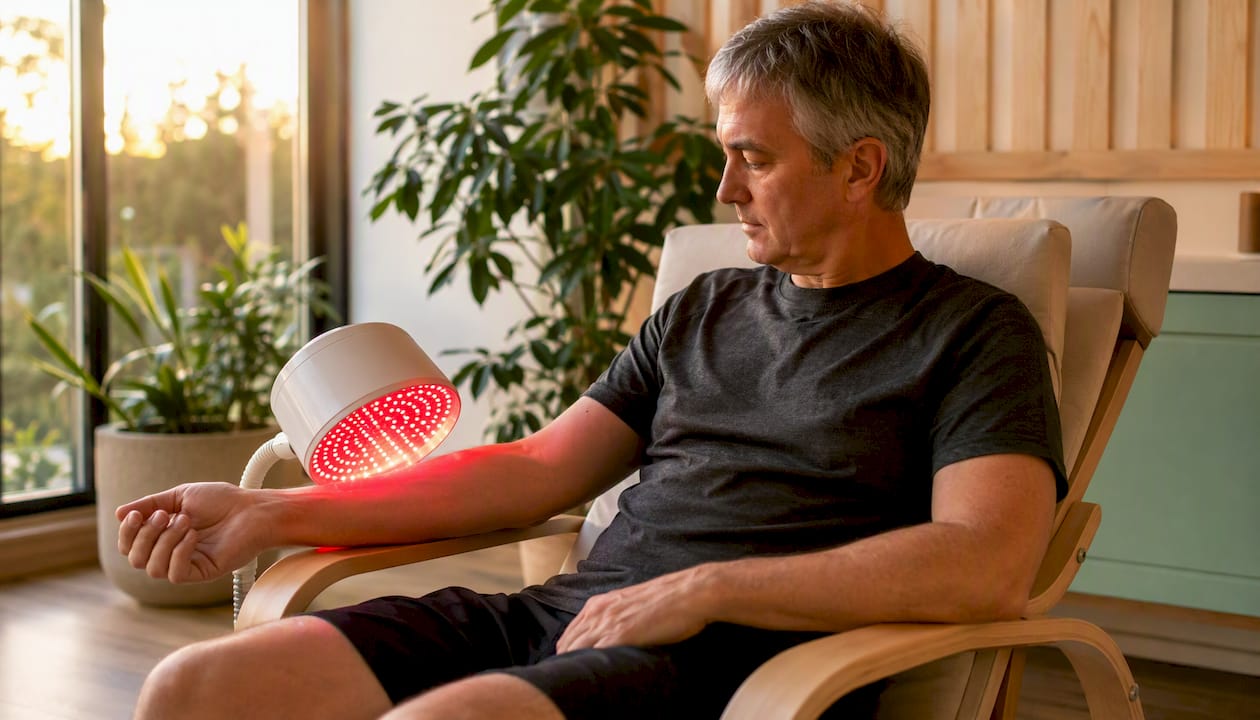
Multiple 2024–2025 network meta-analyses and randomized trials show meaningful pain and function benefits for knee osteoarthritis. Evidence for rheumatoid arthritis is mixed and lower certainty.
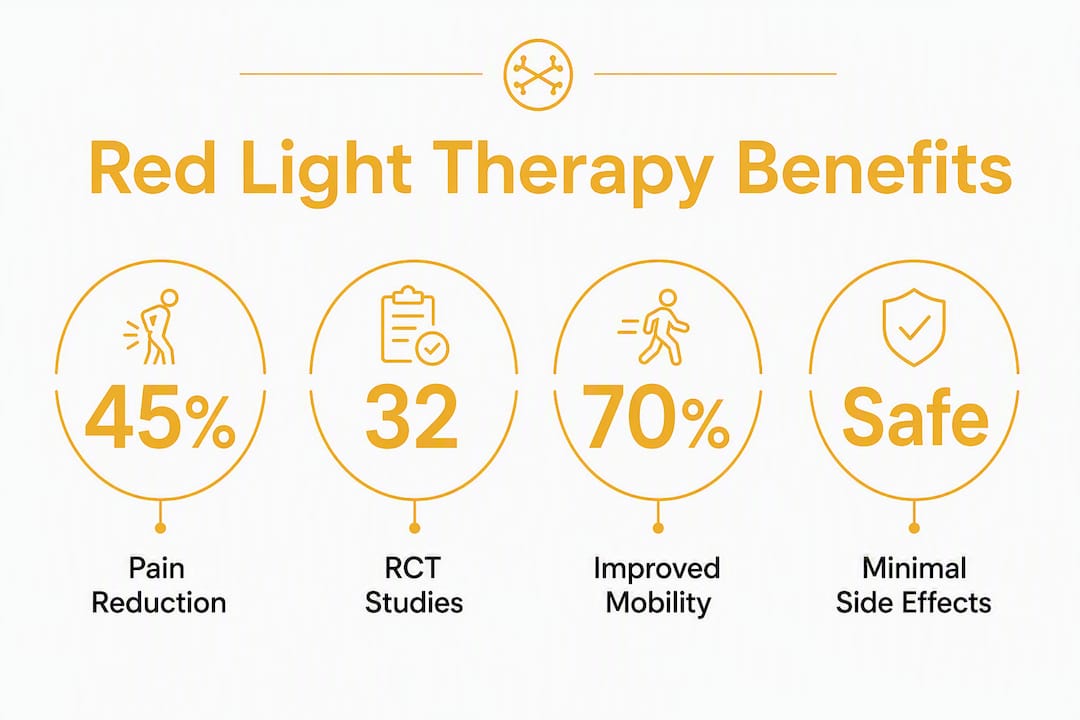
Key finding: A 2025 network meta-analysis of 32 RCTs and 2,078 patients ranked LLLT highest for pain reduction and functional improvement among physical therapies for knee OA.
| Condition | Evidence strength | Typical outcomes |
|---|---|---|
| Knee osteoarthritis | Strong | Meaningful pain reduction, improved function and stiffness scores after 4–8 weeks |
| Rheumatoid arthritis | Low–moderate | Mixed results; some anti-inflammatory benefit in animal and cell studies, but human trial evidence is low-quality and uncertain |
| Bone density endpoints | Emerging | Preclinical data promising; human RCTs limited; best used as adjunct to osteogenic loading |
The honest limitation: trial heterogeneity is significant. Studies use different wavelengths, irradiance levels, session lengths, and patient populations, making direct comparisons difficult. That inconsistency is an argument for choosing a clinic that follows published dosimetry guidelines rather than improvising.
Safety, side effects, and who should get clearance first
Red light therapy has a low risk profile when delivered clinically, but specific contraindications and precautions exist. Common side effects and precautions include:
- Temporary warmth or mild redness at the treatment site, usually resolving within an hour
- Rare transient skin irritation with high-dose laser protocols
- Eye protection required during every session without exception
- Photosensitizing medications (tetracyclines, fluoroquinolones, certain NSAIDs, St. John’s Wort, some diuretics) can increase sensitivity; always disclose your full medication list
- Active cancer in or near the treatment field requires physician clearance before starting
- Pregnancy warrants caution; most clinics defer to the patient’s OB-GYN
For a full breakdown of who should avoid treatment, the red light therapy contraindications guide covers each category in detail.
Pro Tip: Before your first session, ask the clinic for the device’s irradiance spec (in mW/cm²) and wavelength range, and confirm that staff screen for photosensitizing medications and cancer history during intake. A clinic that cannot answer those questions is not running a clinical-grade program.
If you take disease-modifying antirheumatic drugs (DMARDs) or biologics for RA, do not stop or reduce them. PBM research actually suggests it may work synergistically with methotrexate, not against it.
Why clinical devices outperform home units for joint and bone targets
Clinical panels and near-infrared devices used in professional settings generally deliver the irradiance and wavelength mix necessary to reach joint structures. Most home wands do not.
| Parameter | Clinical standard | Why it matters |
|---|---|---|
| Wavelength (red) | 630–660nm | Penetrates surface tissue, reduces synovial inflammation |
| Wavelength (NIR) | 810–850nm | Reaches deeper joint structures and bone |
| Irradiance | — | Below ~50 mW/cm² often fails to penetrate deep joints |
| Session duration | 10–20 minutes per area | Longer is not always better due to biphasic response |
| Treatment distance | 6–12 inches | Affects delivered dose significantly |
A wavelength optimization review found the 785–860nm range produced the most consistent improvements in knee OA trials, which aligns with what clinical panels are built to deliver.
Clinical vs. home devices at a glance:
- Clinical panels: Higher irradiance, dual-wavelength coverage, staff-calibrated dosing, full-body or targeted formats
- Home devices: Lower cost, lower power, suitable for maintenance between clinic visits but generally insufficient as a primary treatment for deep joint conditions
What to expect from a clinical protocol
Most responders need a consistent trial of 4–8 weeks before judging effectiveness. Some people notice reduced morning stiffness within the first two weeks; larger functional gains take longer to accumulate.
A typical in-clinic session follows this sequence:
- Check-in and screening — medication review, contraindication confirmation
- Skin prep — bare skin over the treatment area, no heavy lotions or sunscreen
- Eye protection — goggles on before the panel activates
- Panel exposure — 10–20 minutes per area at the recommended dosage
- Post-session notes — staff document response; exercise or loading session can follow
For frequency, the standard approach is daily or every-other-day sessions during the initial 4–8 week phase, then maintenance at 3–4 sessions per week. Consistency matters more than session length. Sporadic long sessions do not substitute for regular shorter ones.
Track three things: pain score (0–10 scale), morning stiffness duration, and a functional marker like stair climbing or walking distance. If nothing shifts after eight weeks of consistent sessions, the protocol or device specs need reassessment.
How red light therapy pairs with osteogenic loading and other clinic services
RLT is complementary. It reduces inflammation and improves tissue readiness so that osteogenic loading sessions can be more effective and better tolerated. The sequencing question comes up often: use RLT before a loading session to reduce stiffness and warm up the joint, or after to support recovery. Both are defensible; many clinics default to pre-loading RLT because clients move better going into the session.
Osteostrong centers offer a full stack of complementary services worth knowing by name:
- PEMF mats (pulsed electromagnetic field therapy): supports bone remodeling and reduces inflammation at the cellular level; pairs well with RLT on the same visit
- BioCharger: a multi-energy platform using light, PEMF, and plasma frequencies for recovery and cellular optimization
- PureWave VEMI lounge: combines vibration and electromagnetic stimulation for muscle relaxation and circulation
- Compression therapy, vibration plates, hydromassage lounges: recovery and circulation support between loading sessions
A practical weekly schedule might look like:
Monday — osteogenic loading + RLT (pre-loading)
Wednesday — PEMF mat session
Friday — osteogenic loading + RLT or hydromassage for recovery. That rhythm gives bone-building stimulus twice weekly with consistent anti-inflammatory support between sessions.
How to choose a clinic that actually delivers therapeutic results
Choose clinics that publish device specs, offer staff-led dosing, and integrate RLT with osteogenic loading and therapies like PEMF. Here is the checklist to run through before committing:
- Ask for wavelength and irradiance specs — any legitimate clinic can provide these
- Confirm session duration and frequency guidance specific to arthritis or joint pain
- Verify contraindication screening — staff should ask about medications and cancer history at intake
- Ask how RLT integrates with osteogenic loading or PEMF — a clinic with no answer has no protocol
- Request anonymized outcome summaries for clients with similar conditions
- Ask about pricing, membership options, and any insurance support — most PBM sessions are out-of-pocket; bundled packages with osteogenic loading are common
Red flags: any clinic that refuses to share device specs, promises immediate or permanent cure, or pushes over-the-counter device sales without clinical oversight.
On cost: clinical red light therapy is rarely covered by insurance in the United States. Most people pay per session or through a membership package. Bundling RLT with osteogenic loading at a center like Osteostrong typically costs less than purchasing sessions separately.
Real-world client examples
Many clients report earlier improvements in stiffness and activity tolerance, with pain reductions following over weeks rather than days.
Case 1 — Knee OA with osteopenia (60s, female): Baseline knee pain rated 7/10, difficulty with stairs. Protocol: RLT three times weekly (NIR panel, 15 minutes per knee) plus weekly osteogenic loading. By week 6, pain dropped to 3/10 and stair climbing was pain-free. BMD follow-up at 12 months showed modest improvement.
Case 2 — Bilateral knee pain, post-menopausal (70s, female): Chronic stiffness lasting 45+ minutes each morning. Added RLT pre-loading sessions. Morning stiffness resolved to under 10 minutes by week 4; loading sessions became more tolerable and she progressed to higher resistance levels.
Case 3 — RA with systemic inflammation (50s, male): Mixed results. Localized knee symptoms improved modestly, but systemic flares were unaffected by RLT alone. Required coordination with his rheumatologist to adjust DMARD dosing. Outcome: RLT as a supportive tool only, not a primary intervention. His case underscores why RA clients should keep their prescribing physician in the loop throughout any adjunct therapy.
Objective markers worth tracking across all cases: pain scale, timed-up-and-go test, morning stiffness duration, and DXA scan results at 12-month intervals when bone density is a primary goal. Before-and-after comparisons on these measures give a clearer picture than subjective impression alone. For more on what real results look like, the red light therapy before-and-after guide covers documented outcomes in detail.
Key Takeaways
Clinical red light therapy is a well-supported adjunct for knee osteoarthritis pain that works best when paired with osteogenic loading, consistent dosing, and clinical-grade equipment delivering 630–850nm wavelengths.
| Point | Details |
|---|---|
| Strongest evidence: knee OA | A 2025 network meta-analysis of 32 RCTs ranked LLLT highest for pain and function in knee osteoarthritis. |
| Device specs matter | Clinical panels with sufficiently high irradiance and appropriate wavelength range are needed to reach deep joint structures. |
| Commit to 4–8 weeks | Most responders need consistent sessions over 4–8 weeks; quitting early misses cumulative benefits. |
| RLT complements, not replaces | Continue prescribed arthritis medications and osteogenic loading; RLT is an adjunct, not a standalone treatment. |
| Osteostrong integration | Osteostrong centers combine RLT with osteogenic loading, PEMF mats, BioCharger, and PureWave VEMI lounge for a complete bone-health program. |
Why Osteostrong integrates red light therapy with bone-building programs
From my perspective, the most underutilized aspect of red light therapy for arthritis is not the therapy itself — it is the sequencing. Most people either use RLT in isolation or bolt it onto an existing routine without any protocol logic. What actually moves the needle is pairing it with a mechanical stimulus that gives bone and joint tissue something to adapt to.
Osteostrong was built around that principle. Osteogenic loading creates the mechanical signal that drives bone remodeling. RLT reduces the inflammatory noise that would otherwise blunt recovery and make loading sessions harder to tolerate. PEMF mats, the BioCharger, and the PureWave VEMI lounge each add a layer of cellular and circulatory support that compounds over time. None of these modalities is a magic bullet alone. Together, with a consistent weekly schedule, they address bone density and joint health from multiple angles simultaneously.
The clients who see the best results are not the ones who do the most sessions. They are the ones who show up consistently, track their markers, and adjust based on what the data shows. That is the clinical discipline that separates a real program from a wellness trend.
Ready to try red light therapy with clinical-grade support?
If you have been managing arthritis pain or working to protect bone density, Osteostrong offers a program built around exactly this combination: osteogenic loading, clinical red light therapy, PEMF mats, BioCharger, PureWave VEMI lounge, compression therapy, vibration plates, and hydromassage, all under one roof.

For your first visit, bring your most recent DXA or BMD report if you have one, a current medication list, comfortable clothing, and any questions about photosensitivity screening. Staff will review your history, walk you through device specs, and build a session plan that fits your condition and goals.
Find a center near you and book a session at Osteostrong. Locations including Stonebridge and Red Rock offer the full integrated service set. Membership and pay-per-session options are available; ask about bundled packages that combine osteogenic loading and red light therapy for the best per-session value.
Useful sources
- Current advances of photobiomodulation therapy in treating knee osteoarthritis (PMC)
- Mechanisms and applications of the anti-inflammatory effects of photobiomodulation (PMC)
- Network meta-analysis: LLLT for knee OA outcomes (PMC11976336)
- Systematic review on wavelength optimization for knee OA (PMC11455796)
- Effects of low-level laser therapy in adults with rheumatoid arthritis (PLOS One)
- Red light therapy: What the science says (Stanford Medicine)
- Red Light Therapy Dosage: A Bone Health Guide
- Red Light Therapy for Bone Density: 2026 Guide