
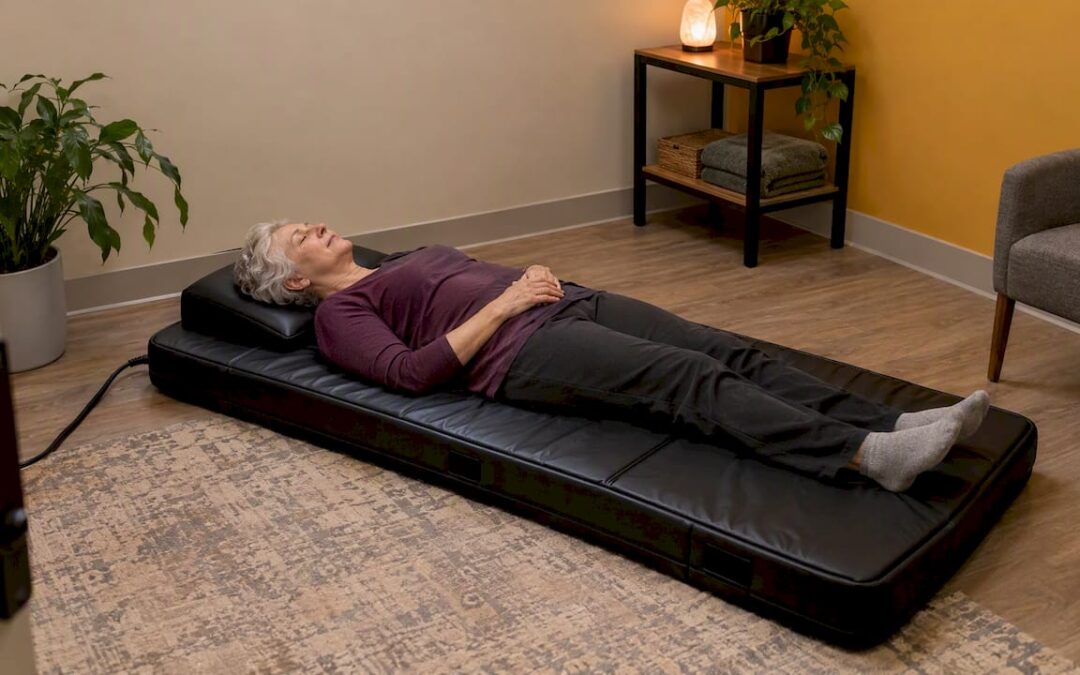
PEMF may take the edge off some kinds of pain, but the evidence is uneven. It looks most promising for osteoarthritis and for spinal or nerve-root pain. It is weaker for chronic low-back pain, where studies show some pain relief but no better physical function. It is not a replacement for bone-density care. If you have osteoporosis or osteopenia, think of it as a possible add-on to treatment your doctor already recommends.
Below we cover what pulsed electromagnetic field therapy is, what trials found for different pain types, who should skip it, and how to judge a session or a home mat.
TL;DR
- PEMF uses pulsing, changing magnetic fields. Static magnets, like those in bracelets and basic wraps, are a different thing and lack conclusive evidence for pain.
- Evidence is strongest for osteoarthritis pain and spinal or radicular pain, mixed for chronic low-back pain, and limited for diffuse peripheral neuropathy.
- In successful trials, protocols ran from 1 to 12 weeks, so a single session is not a fair test.
- Pregnancy, epilepsy, pacemakers, insulin pumps and medication patches are reasons to avoid it or to ask your clinician first.
- With low bone density, PEMF is an adjunct. Weight-bearing loading and your prescribed care come first.
Table of Contents
- What PEMF actually is
- What studies say about PEMF for pain
- Is PEMF safe, and who should avoid it?
- PEMF when you have osteoporosis or osteopenia
- What a sensible PEMF plan looks like
- Our perspective
- Pairing PEMF with weekly loading at our centers
- FAQ
- Sources
What PEMF actually is
PEMF stands for pulsed electromagnetic field therapy. A device sends low-level electromagnetic pulses into the body, either through a whole-body mat or a smaller applicator placed on one area. The Cleveland Clinic describes it as delivering safe doses of electromagnetic waves, and notes that experts are still studying its potential benefits.
The pulsing matters. The National Center for Complementary and Integrative Health explains that static magnets have fields that are always on and never change, while PEMF devices use electric current to generate a magnetic field that pulses. A mat or wrap sold as magnetic does not automatically deliver what clinical studies tested. That is the first question to ask any provider: what are the device’s actual settings?

What studies say about PEMF for pain
The honest answer is that it depends on the kind of pain. Researchers reviewing the field describe it as fragmented, and they argue that future protocols should be matched to the cause of the pain, mechanical or inflammatory, instead of applied generically (systematic review in musculoskeletal pain).
| Pain type | What the evidence suggests | How firm it is |
|---|---|---|
| Osteoarthritis (knee, hand, others) | A systematic review of 17 studies and 1,197 patients reported a 60% decrease in VAS pain scores and a 42% improvement in WOMAC scores after 15 to 90 days of treatment | Encouraging, mostly short-term |
| Spinal and radicular (nerve-root) pain | A 2026 meta-analysis found a clinically meaningful effect (SMD of -2.35) | Promising, but pooled results vary |
| Chronic low-back pain | Low to moderate quality evidence of reduced pain, and no evidence of improved physical function | Modest |
| Diffuse peripheral neuropathy | Limited efficacy in the same meta-analysis | Weak |
| Back pain after vertebral fracture | In postmenopausal women, 3 months of PEMF was linked to better back pain, body function and bone microstructure | Small trial, adjunct use |
The osteoarthritis figures come from a systematic review of PEMF in osteoarthritis. The spinal and neuropathic results come from a 2026 meta-analysis on neuropathic pain. The low-back summary is from a PAIN+ evidence summary. The fracture trial is here.
What this means for PEMF and back pain
If your back pain is chronic and nonspecific, expect a modest effect at best. The evidence summary above found reduced pain but no gain in physical function. That is a useful reminder: feeling a bit better is not the same as moving, lifting and walking better. For function you still need strength work, movement and, where appropriate, physical therapy.
If your back pain follows a vertebral fracture, the picture is a little different. The trial in postmenopausal women with vertebral fractures reported improvements in pain, function and bone microstructure at the tibia and radius after 3 months. It was a single study, so treat it as a reason to discuss PEMF with your surgeon or physician, not as a promise.
Why results vary so much
Three reasons come up repeatedly.
- Dose and settings. Lower frequencies, often 1 to 30 Hz, are common in studies, but reviewers found no single ideal frequency for every type of pain.
- Duration. Successful trials generally ran 1 to 12 weeks, with sessions anywhere from 2 to 7 days a week. One visit tells you almost nothing.
- Device quality. Professional devices and generic wellness mats can deliver very different energy levels. A mat at home may not match what a trial used, and no one has standardized this for consumers.
The likely mechanism is modulation of inflammation and circulation, not some singular healing property. That fits the pattern above: inflammatory joint pain responds better than diffuse nerve pain.
Is PEMF safe, and who should avoid it?
For most healthy adults, PEMF is described as low risk, but there are clear exceptions. The Cleveland Clinic advises avoiding it if you are pregnant, have epilepsy, use a medical device such as a pacemaker or insulin pump, or wear medication patches. If any of those apply, talk to your cardiologist, endocrinologist, neurologist or obstetrician before any session or purchase.
Two more practical points:
- Healthcare providers remain the main resource for deciding intensity and duration, and at-home devices should not stand in for a clinical evaluation of new or worsening pain.
- Insurance coverage for these therapies is inconsistent, so ask about costs before you commit. Our guide to PEMF therapy cost for bone health walks through what to ask.
New pain after a fall, pain at night that wakes you, numbness, or pain with fever or weight loss calls for a medical visit first, not a wellness session. With osteoporosis, sudden severe back pain can signal a spinal fracture, and that needs imaging and a physician.
We cover reactions in more detail in our piece on PEMF therapy side effects.
PEMF when you have osteoporosis or osteopenia
This is where many readers land with the wrong expectation. PEMF is usually used as an adjunct, not a primary treatment. The fracture study above saw back pain and microstructure improve, yet it did not necessarily show immediate, significant changes in hip bone density measurements. So PEMF should not replace therapies your doctor prescribed to protect bone density.
Professional consensus is consistent: PEMF is a complementary approach, and it works best next to the conservative measures with the strongest evidence, such as weight-bearing exercise, strength training and physical therapy. For comparison, the American Academy of Orthopaedic Surgeons guideline on knee osteoarthritis points patients toward self-management programs, strengthening, low-impact aerobic exercise and neuromuscular education.
If you want to see how PEMF fits next to bone work, these pages go deeper: where PEMF helps and where it does not, PEMF for adults with low bone density, and how PEMF compares with EMS for rehab.

What a sensible PEMF plan looks like
Whatever you choose, a plan that matches the research looks like this:
- Name the pain. Joint wear, nerve-root irritation, post-fracture soreness and general muscle tension are different problems.
- Clear it with your clinician if you have an implant, a pump, a patch, epilepsy or a pregnancy, or if the pain is new.
- Ask for device parameters. Frequency range, intensity and session length should be answerable. Vague claims about magnetic energy are a warning sign.
- Commit to a trial window. Several weeks of regular sessions, with a simple 0 to 10 pain score before each, will tell you more than one visit. Typical session lengths are covered in our guide to PEMF sessions alongside bone loading.
- Stop and reassess if there is no change after the window, or if symptoms worsen.
- Keep the foundations. Strength, loading and movement stay in place throughout.
Hands-on care can also sit alongside this. Many people pair a PEMF trial with deep tissue and trigger point massage, because both rely on a series of individualized sessions rather than a single visit.
Home mat or clinic?
A home mat is convenient, but you cannot easily verify that its output matches clinical parameters, and it should not replace professional evaluation. A clinic can tell you what device it uses and set sessions around your history. If you are weighing the home route for bone loading too, see our practical guide to osteogenic loading at home.
Our perspective
We run wellness centers in Rancho Cordova, El Dorado Hills and Granite Bay, and our members have osteoporosis or osteopenia. Pain is often what brings them in. It is rarely the whole story.
What we tell people is simple. PEMF can be a pleasant, low-effort part of a routine, and the research on certain pain types is encouraging. But it is a support act. The work that changes how a skeleton behaves is mechanical: brief, supervised, weekly osteogenic loading that asks bone to respond to force. That is our core service, and we offer PEMF mats alongside it so members can add recovery work without a separate trip.
We also push back on hype. A mat that is magnetic is not a PEMF device with known settings. A few sessions do not prove anything. And if your pain is new, sharp or sudden, you need your physician, not a mat. We would rather you ask hard questions of us than buy something on a promise.
— Aaron
Pairing PEMF with weekly loading at our centers
If you want to try PEMF as part of a bone-health routine, we offer it next to osteogenic loading, an evidence-based, non-pharmaceutical protocol built around one brief, supervised session a week. Our team can talk through your history, your pain and any implants or devices before you start. Learn more about osteogenic loading at OsteoStrong, or read how the approach performs in trials and clinic results. Pricing for osteogenic loading is not published online, so contact the center nearest you.
FAQ
Does PEMF work for back pain?
Sometimes, and modestly. For chronic low-back pain, evidence of low to moderate quality suggests reduced pain, with no improvement in physical function. Results look stronger for spinal and radicular pain, but protocols vary. Ask your clinician whether your type of back pain fits.
Is PEMF therapy real or fake?
The technology is real: PEMF devices produce pulsing magnetic fields, and trials exist for several conditions. The claims are what vary. Evidence is encouraging for osteoarthritis and mixed or weak for other pain types, and experts are still studying it. Be wary of products that promise cures or cannot state their settings.
Who should not do PEMF therapy?
The Cleveland Clinic advises people who are pregnant, have epilepsy, use a pacemaker or insulin pump, or use medication patches to avoid it. Speak with the physician who manages that condition or device before trying it. If your pain is new or severe, get it evaluated first.
What frequency of PEMF is good for pain?
Studies often use low frequencies, around 1 to 30 Hz, but reviewers found no universally ideal frequency for all pain types. Effective protocols tend to be tailored to the condition. That is why a clinician-guided setting is safer than guessing on a home device.
Sources
- Cleveland Clinic: PEMF therapy overview
- NCCIH: Magnets for pain
- Systematic review: PEMF in osteoarthritis
- Meta-analysis: PEMF on neuropathic pain
- PAIN+ evidence summary: PEMF and low back pain
- Trial: PEMF in postmenopausal women with vertebral fractures
- Systematic review: electromagnetic fields in musculoskeletal pain
- AAOS: Treatment of osteoarthritis of the knee, 2nd edition