

Most patients on bisphosphonate therapy get reassessed after 3 to 5 years, and those at low-to-moderate fracture risk can often take an osteoporosis drug holiday lasting 2 to 3 years. Denosumab is the exception. Stopping it without a planned transition drug can trigger a rebound in vertebral fractures, so that decision follows a completely different playbook than the one for oral or IV bisphosphonates.
A narrative review of the evidence backs the 2 to 3 year window for most patients coming off long-term bisphosphonate treatment, though the exact length shifts based on which drug you took, how consistently you took it, and your current fracture risk. Some patients should not pause treatment at all. If any of the following apply to you, a holiday is usually off the table until your clinician says otherwise:
- A prior hip or vertebral fracture
- A femoral neck T-score that remains very low despite treatment
- Advanced age combined with elevated fall risk
- High-dose glucocorticoid (steroid) use
- A new fracture that occurred while already on therapy
Quick fact: guidelines from the Endocrine Society specifically call for reassessing fracture risk at the 3 to 5 year mark, not for defaulting into a holiday automatically.
Key Takeaways
A bisphosphonate holiday works because these drugs stay bound to bone for years after the last dose, but denosumab requires planned transition, not a pause, to avoid rebound fractures.
| Point | Details |
|---|---|
| Reassess at 3 to 5 years | Guidelines call for a fracture-risk checkup after 3 to 5 years of bisphosphonate therapy, not an automatic holiday. |
| Typical holiday length | Most low-to-moderate risk patients take a 2 to 3 year pause, with a possible range of 1 to 5 years. |
| Denosumab is different | Stopping denosumab without a planned bisphosphonate transition around 6 months later raises rebound vertebral fracture risk. |
| Monitor every 2 to 4 years | Reassess bone density and fracture risk on that cycle, adjusted for your specific drug and risk profile. |
| Support bones mechanically | Osteogenic loading through OsteoStrong offers a supervised, weekly option to complement exercise and nutrition during a holiday. |
This article is general information, not a substitute for advice from a qualified doctor. Consult a qualified healthcare professional about your own circumstances before acting on anything here.
Table of Contents
- What Is a Bisphosphonate Drug Holiday and Why Does It Work?
- When Should You Start a Bisphosphonate Holiday, According to Guidelines?
- What Factors Should Change How Long Your Holiday Lasts?
- Do the Benefits of a Drug Holiday Outweigh the Risks?
- How Often Should You Get Monitored During a Drug Holiday?
- Are There Exceptions for Denosumab, Men, or Steroid-Induced Osteoporosis?
- What Can You Do to Protect Your Bones While You’re Off Medication?
- Your Drug Holiday Bottom Line
- A Note From Aaron on Navigating This Decision
- How OsteoStrong Can Support You Through a Drug Holiday
- Sources
What Is a Bisphosphonate Drug Holiday and Why Does It Work?
A bisphosphonate holiday is a planned, temporary pause in medication after a period of sustained treatment, not a decision to abandon bone care. It works because of a quirk in how these drugs behave once they’re inside you: bisphosphonates bind directly to bone mineral and stay lodged there for years after your last dose, continuing to suppress the cellular activity that breaks bone down.
That long residency is the entire reason a holiday is medically defensible. Alendronate, risedronate, and zoledronate all attach to hydroxyapatite crystals in bone tissue and get released gradually as bone remodels, which means their protective effect doesn’t vanish the day you stop swallowing a pill or getting an infusion. Denosumab works completely differently. It’s a monoclonal antibody that blocks a signaling protein called RANKL, and it doesn’t accumulate in bone at all. Its effect switches off within months of the last injection, which is exactly why denosumab can’t be paused the same way.
The clinical evidence for residual protection after bisphosphonates comes largely from two landmark extension trials. The FLEX trial followed women who had taken alendronate for 5 years and then either continued or stopped, finding that bone turnover markers stayed suppressed and fracture protection persisted for several more years in the group that stopped. The HORIZON extension studied the same question with zoledronate, showing a similar carryover effect after IV dosing.
Statistic callout: Extension data from FLEX and HORIZON is the primary reason clinicians feel comfortable recommending a pause at all. Without that residual protection window, the entire concept of a “holiday” wouldn’t exist for bisphosphonates.
- Alendronate and risedronate: oral tablets, bind bone, release slowly over years
- Zoledronate: IV infusion, binds even more tightly, longest residual effect
- Denosumab: injectable antibody, no bone binding, effect reverses quickly
When Should You Start a Bisphosphonate Holiday, According to Guidelines?
The Endocrine Society’s clinical practice guideline recommends reassessing fracture risk after 3 to 5 years of bisphosphonate therapy, and considering a holiday specifically for patients who fall into the low-to-moderate fracture risk category at that checkpoint. High-risk patients are generally advised to continue.
Timing in practice tends to follow the route of administration:
- Oral bisphosphonates (alendronate, risedronate): reassessment typically comes after around 5 years of continuous use.
- IV zoledronate: reassessment typically comes sooner, around 3 years, since IV dosing delivers a larger cumulative exposure per infusion.
- Holiday length: commonly 2 to 3 years, though it can range from 1 to 5 years depending on your bone density, prior fracture history, and which drug you were on.
A primary-care-focused review offers a more operational version of this same rule: offer a holiday to patients who’ve completed 5 years of oral therapy or 3 years of IV therapy, provided they’re not classified as high risk. That review also lays out when to loop in a bone specialist, which matters if your case doesn’t fit neatly into the standard profile.
It’s worth being honest about where this guidance comes from. Much of it traces back to extension trials and observational cohorts rather than head-to-head randomized trials comparing different holiday lengths directly. High-quality trial evidence comparing, say, a 2-year holiday against a 4-year holiday essentially doesn’t exist yet, which is a real limitation acknowledged even within the Endocrine Society guideline itself. Most of the underlying research was also conducted in postmenopausal women, so if you’re a man or you developed osteoporosis from steroid use, the guidance applies less directly to your situation.
Quick fact: the systematic review behind much of this field covered 61 separate studies and confirmed that long-term alendronate and zoledronate meaningfully reduce fractures, while flagging that the evidence specifically on holiday effects and harms remains limited.
What Factors Should Change How Long Your Holiday Lasts?
No two holidays should look identical, because your bones, your history, and your specific drug all change the math. Clinicians typically run through a short mental checklist before settling on a duration, and you can use the same one to prepare for that conversation.
Total exposure and adherence. If you took your bisphosphonate faithfully for the full recommended course, you built up more residual protection than someone who missed doses or stopped early. Poor adherence means less drug actually bound to your bone, which points toward a shorter holiday, not a longer one. This is an underappreciated variable: two people who were both “on alendronate for 5 years” can have very different residual protection if one took 90% of doses and the other took 60%.
Which specific drug you were on. Pharmacology matters here more than people expect.
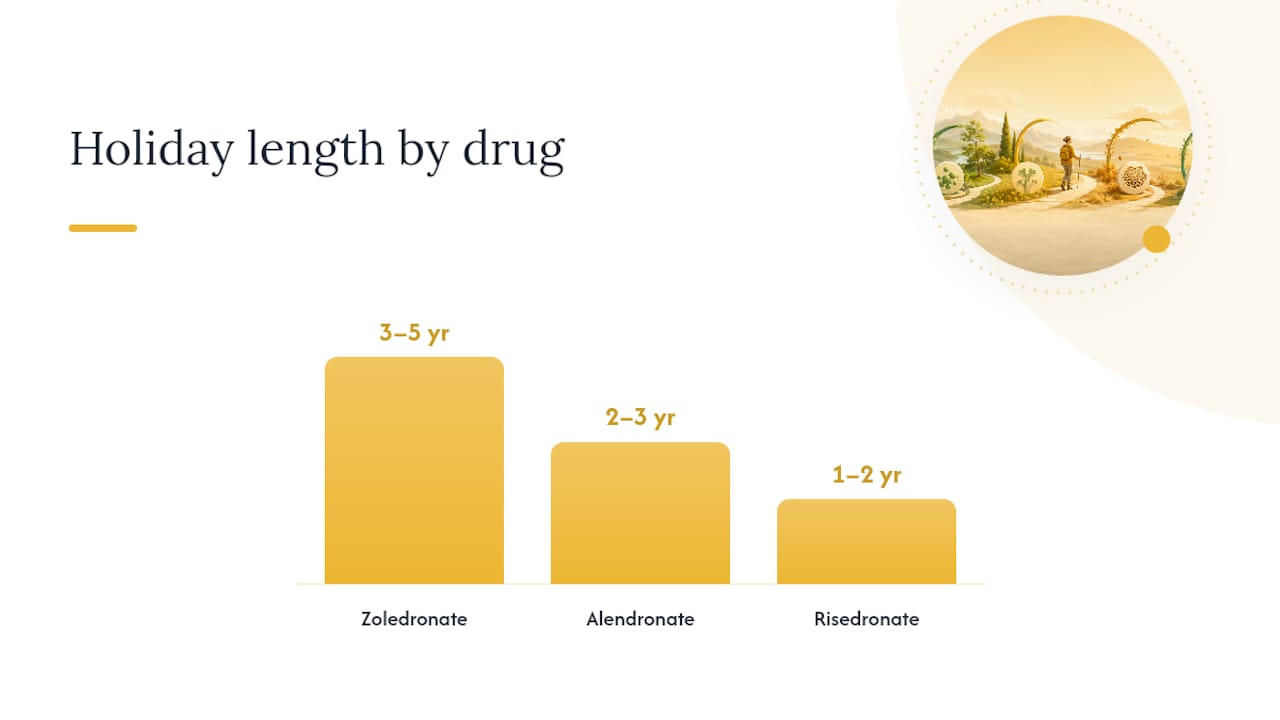
- Zoledronate binds bone the most tightly of the three and tends to support longer holidays, sometimes toward the 3 to 5 year range.
- Alendronate sits in the middle, generally supporting the standard 2 to 3 year window.
- Risedronate clears the body somewhat faster than the other two, which sometimes argues for a shorter pause, closer to 1 to 2 years.
Clinical risk features. A prior fracture, a femoral neck T-score below key thresholds your clinician will check, older age, a history of falls, or any glucocorticoid exposure all push toward either a shorter holiday or continuing therapy altogether. These aren’t minor details. A patient with a T-score of negative 3.0 and no fracture history is a different case than one with the same T-score and a prior vertebral fracture.
When to bring in a specialist. Recurrent fractures despite treatment, bone density that keeps dropping instead of holding steady, reduced kidney function (creatinine clearance issues can affect which drugs are even safe to use), or symptoms suggestive of an atypical femoral fracture (unusual thigh or groin pain) or osteonecrosis of the jaw (persistent jaw pain, exposed bone after dental work) all warrant a referral to an endocrinologist or bone specialist rather than a default decision in a primary care visit.
Pro Tip: Bring your full medication adherence history to this conversation, not just the prescription start date. “I was prescribed alendronate for 5 years” and “I took alendronate consistently for 5 years” are two different clinical pictures, and your clinician needs to know which one is true.
Do the Benefits of a Drug Holiday Outweigh the Risks?
The case for a holiday rests on avoiding two rare but serious long-term complications: atypical femoral fractures (AFF) and osteonecrosis of the jaw (ONJ). Both are associated with prolonged bisphosphonate exposure, and observational data suggests stepping back from therapy reduces the odds of either developing. Neither complication is common even among long-term users, but their severity, an AFF often requires surgery, and ONJ can be difficult to treat, is why they weigh heavily in the risk-benefit conversation despite their rarity.
The tradeoff is fracture risk during the pause itself. A systematic review covering dozens of studies confirmed that long-term bisphosphonate use meaningfully reduces fractures, but found the evidence specifically addressing what happens during a holiday, and for how long protection actually lasts, is thinner and less consistent than the evidence for the drugs’ benefits in the first place.
An observational cohort study tracking 264 patients who discontinued bisphosphonates found that fractures occurred in about 12.3% of the group during the holiday period, and that these fractures clustered heavily among patients who already had high-risk profiles going in. Many were clinical vertebral fractures, and a notable share showed up within the first year off treatment, not years later.
Here’s the practical framing that emerges from all of this:
- Low-to-moderate risk patients: holiday benefits (avoiding AFF/ONJ) likely outweigh the modest fracture risk during the pause.
- High-risk patients: the small absolute increase in fracture risk, particularly vertebral fractures, during a holiday may outweigh the AFF/ONJ benefit, favoring continued therapy.
- The data is overwhelmingly drawn from postmenopausal women, so risk calculations carry more uncertainty for men and for glucocorticoid-induced cases.
None of this is a clean equation. It’s a judgment call built on incomplete data, which is exactly why individual risk profiling matters more here than in most medication decisions.
How Often Should You Get Monitored During a Drug Holiday?
A drug holiday isn’t a break from care, it’s a shift to a different kind of care, one built around watching for change rather than suppressing it chemically. The monitoring cadence most clinicians use looks like this:
- Reassess fracture risk and bone density every 2 to 4 years while off treatment, with the exact interval tailored to which drug you were on and how high your baseline risk was. Zoledronate patients with strong residual protection might go closer to 4 years between checks; alendronate or risedronate patients with more borderline risk profiles often get checked closer to the 2-year mark.
- Watch for restart triggers, which include any new fragility fracture, a meaningful drop in hip or femoral neck bone density on a follow-up scan, the introduction of a new major risk factor like starting glucocorticoids for an unrelated condition, or symptoms suggestive of AFF or ONJ.
- Don’t lean too heavily on bone turnover marker blood tests as your main decision tool. These markers do shift during a holiday, but they aren’t validated as the primary trigger for restarting therapy. Clinical judgment, your fracture history, your scan results, and your overall risk trajectory still drive the decision more than a single lab value does.
Pro Tip: Ask your clinician to write down, in your chart or on paper you keep, the specific bone density number that would trigger a restart for you. A T-score or BMD threshold you can check against your own future scan is far more useful than a vague “we’ll keep an eye on it.”
Are There Exceptions for Denosumab, Men, or Steroid-Induced Osteoporosis?
Denosumab deserves its own rule, separate from everything above, because stopping it behaves nothing like stopping a bisphosphonate. Without bone binding to fall back on, its antiresorptive effect reverses within months, and that reversal can trigger a rebound surge in bone turnover that raises vertebral fracture risk above baseline. Guidance from the Endocrine Society is explicit on this: if you’re stopping denosumab, you need a planned transition to a potent bisphosphonate, typically zoledronate, given around 6 months after your last denosumab dose, to blunt that rebound effect. There is no unsupervised denosumab holiday.
Men present a different complication. Osteoporosis in men is more often tied to an identifiable secondary cause, low testosterone, alcohol use, certain medications, than in postmenopausal women, which means the standard holiday framework (built almost entirely on female trial populations) may not transfer cleanly. Any holiday decision for a male patient needs individualized evaluation rather than a default to the standard timeline.
Glucocorticoid-induced osteoporosis (GIOP) is its own high-risk category. Steroids actively suppress bone formation while you’re taking them, so a holiday usually doesn’t make sense unless the steroid course has actually ended and your fracture risk has measurably come back down. Pausing bisphosphonate protection while steroids are still in the picture removes a safeguard at precisely the wrong moment.
- Denosumab: plan the bisphosphonate handoff before you stop, not after
- Men: individualized workup for secondary causes before any holiday discussion
- GIOP: holiday timing depends on steroid status, not just bisphosphonate duration
What Can You Do to Protect Your Bones While You’re Off Medication?
A holiday shifts more responsibility onto lifestyle and mechanical bone loading, and the research on what actually helps is fairly consistent. Weight-bearing activity, progressive resistance training, and balance work make up the core of evidence-aligned exercise during this period, since each targets a different piece of fracture risk: bone density, muscle support around joints, and fall prevention, respectively.

This is where osteogenic loading fits as a mechanical complement to what your bones are missing without medication. It applies brief, high-intensity axial loads that signal bone-building cells to activate, working through a different pathway than the drugs themselves but toward the same goal of maintaining density.
Nutrition matters just as much as movement. Adequate calcium, vitamin D, and protein intake all support bone remodeling, and specific food targets are easier to hit than most people assume once you know the numbers. Smoking cessation and limiting alcohol both measurably reduce fracture risk independent of anything else you’re doing.
- Prioritize weight-bearing and progressive resistance exercise several times weekly
- Hit daily calcium, vitamin D, and protein targets consistently, not sporadically
- Fall-proof your home: secure rugs, improve lighting, add grab bars where needed
- Keep your clinician updated on your exercise and monitoring plan, not just your scan results
Pro Tip: Ask whether a supervised program tracking your bone-loading progress makes sense alongside your reassessment scans. A structured plan is far easier to stick with than a mental note to “exercise more” during a multi-year holiday.
Your Drug Holiday Bottom Line
If you’re at low-to-moderate fracture risk after 3 to 5 years of bisphosphonate therapy, a 2 to 3 year osteoporosis drug holiday is a reasonable, evidence-supported option to discuss with your clinician. If you’re on denosumab, high-risk, or managing steroid-induced osteoporosis, that same conversation looks very different.
Before your next appointment, bring this checklist:
- Ask for your exact medication start date and total adherence history.
- Request a hip and femoral neck bone density scan if you haven’t had one recently.
- Ask which specific risk factors (fracture history, T-score, falls, steroids) apply to you.
- Get a written restart trigger, a specific BMD or clinical event that would end the holiday.
- Ask whether your case warrants a referral to an endocrinologist or bone specialist.
- Confirm your next reassessment date before you leave the office.
A Note From Aaron on Navigating This Decision
Patients often come to us mid-conversation with their doctor, unsure whether pausing medication means giving up on their bones. It doesn’t. The strongest cases I’ve seen for a smooth holiday involve patients who stayed mechanically active and nutritionally consistent the entire time, not just before or after.
This isn’t a decision to make alone, and it isn’t one to make passively either.
— Aaron
How OsteoStrong Can Support You Through a Drug Holiday
Osteogenic loading gives you a mechanical way to keep signaling bone-building activity during the exact window when medication isn’t doing that work for you. Sessions run once weekly, use brief high-intensity loading rather than traditional weight training, and are supervised the entire time.

This isn’t a replacement for your clinician’s monitoring plan, it’s a complement to it, and it’s worth discussing at your next reassessment appointment. Combined with the nutrition targets and fall-prevention steps covered above, a supervised loading program gives you something concrete to do during a holiday instead of just waiting for the next scan. If you’re weighing whether a structured program fits your situation, find your nearest OsteoStrong location and ask about a session that fits around your existing treatment plan.
Sources
- Pharmacological Management of Osteoporosis in Postmenopausal Women — Endocrine Society clinical practice guideline
- Duration of Bisphosphonate Drug Holidays in Osteoporosis Patients: A Narrative Review of the Evidence and Considerations for Decision-Making
- Bisphosphonate Drug Holidays in Primary Care: When and What to Do Next? – PubMed
- Bisphosphonate drug holidays in osteoporosis according to fracture risk profile | Osteoporosis International
Trackbacks/Pingbacks